





If you are preparing a route through northern Tanzania and want a “compact” but full safari flavor park, Lake ManyaraIt's one of those names that come up over and over again. And not just for the flamingos: the big script twist here is an impossible-looking forest, green and dense, fed by groundwater in the middle of the Rift Valley.
In this post I tell you what to see in the Lake Manyara, how to plan a round day in Lake Manyara National Park, when it makes sense to go there (and when not), and how it fits into eternal doubt: Manyara of Tarangire.
Where Lake Manyara is located (and why it is “understood” at a glance)
When someone asks Where is Lake Manyara, the short answer is: in northern Tanzania, at the base of the Great Rift Valley escarpment, between Arusha and Ngorongoro, within the classic northern circuit.
If you think of it as a “mind map,” the Lake Manyara in TanzaniaIt follows a very logical line:
- Arusha (usual entry point)
- Manyara (park + lake)
- Ngorongoro Conservation Area
- Serengeti (if it continues to rise)
It's the kind of place you end up Googling like “map of Africa: Lake Manyara” because, really, grace is how it connects destinations. Or to put it another way: the Lake Manyara in Africait is not an “isolated park”, it is a piece that fits perfectly into an itinerary.
The “underwater forest” of Manyara: what it is and why it is interesting
Manyara is often described as a miniature habitat park. In a few kilometers you pass from the shore of an alkaline lake to plains and suddenly you enter a humid forest that looks like from another country.
This contrast has a very specific culprit: a Groundwater forest(floodplain), fed by springs and water that emerges under the Rift escarpment. TANAPA mentions it as one of the traits that sustain a lot of life, especially primates, and UNESCO also highlights these perennial outcrops that sustain the forest.
Does this “underwater forest” mean that you will see trees under water? Not exactly. The idea is this:
- It is not a submerged forest like in a marine documentary.
- It is a forest that lives “against all logic”, thanks to groundwater and waterled/riparian areas.
- The result: shade, freshness and unusual plant density in a savannah environment.
Visiting tip: when you enter this forest, look up and not just the path. It is where the experience changes: sounds, light, hidden birds, groups of baboons... and that feeling of “I am inside a green tunnel”.
Flamingos on Lake Manyara (and the rest of the cast that doesn't make headlines)
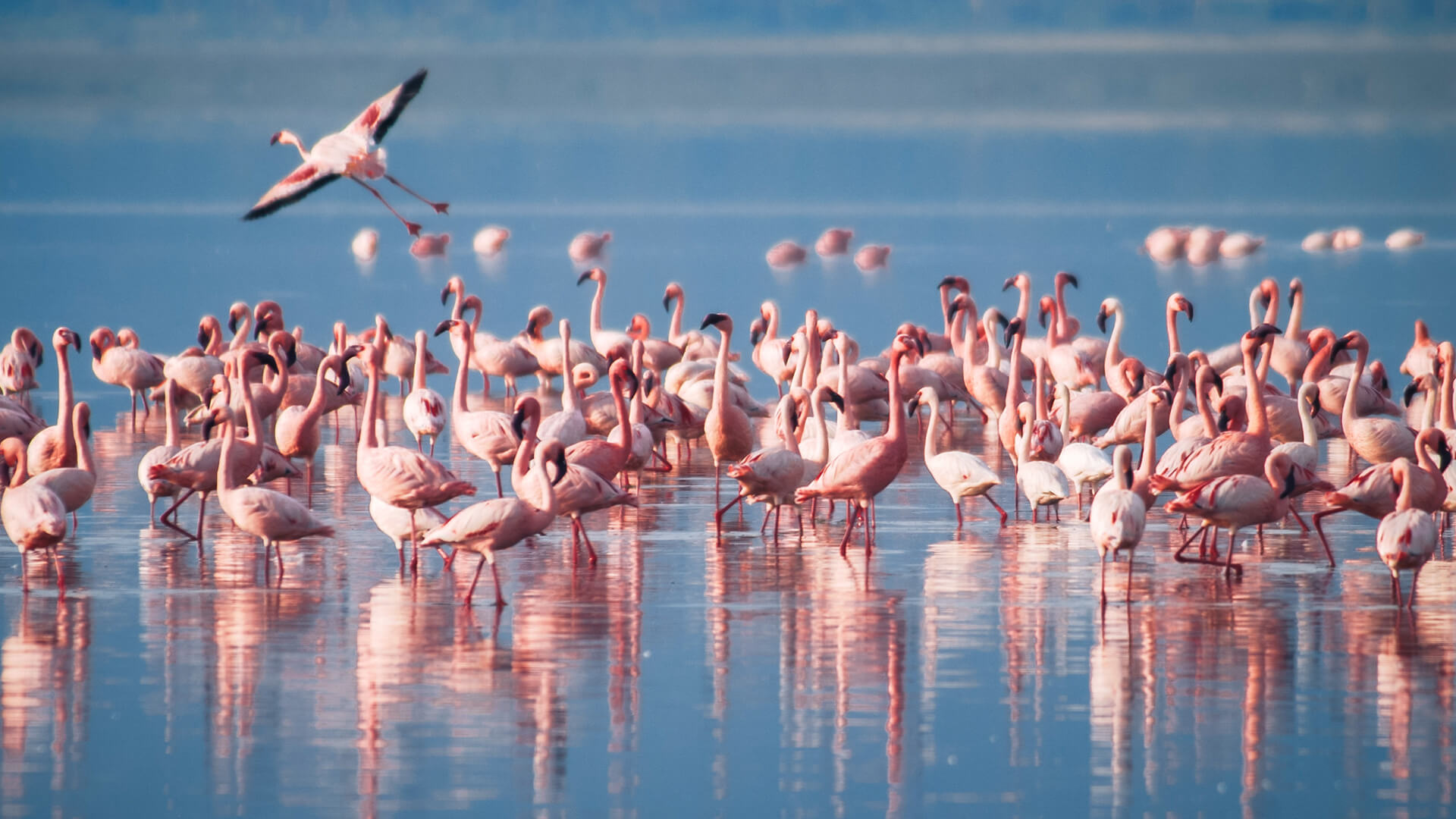
Let's go with the star: Lake Manyaraand “flamingos” have become almost synonymous. And yes, the lake can concentrate huge amounts at specific times, to the point of dyeing the shore pink. TANAPA even mentions very high flamenco counts in specific episodes.
But here is the nuance that avoids disappointments: flamingos move. The level of water, salinity and the availability of food mean that there are seasons with too many and others with less. The experience is real, only it doesn't work like “there's always X”.
Fast birdwatching: herons, raptors and “that day the aufrany comes out”
If you like bird watching, Manyara is a very grateful park. In addition to flamingos, it is easy to find scenes of Sheep in Lake Manyaraon banks and wetlands, and raptors hovering near the escarpment.
And if you are one of those looking for specific species (or have caught yourself typing strange searches), yes: there are people who come here for queries like “aufrany lakac.manyara”. The grace of Manyara is that, by habitat, it can give you surprises: waterfowl in the lake, foresters in the forest and raptors in the transitions.
Photographic mini-tip: for flamingos, prioritize first and last hours for soft light. In the forest, climb the ISO without fear: the shadow rules.
Safari in Lake Manyara National Park: what to see in 1 day (without running like a buffalo is chasing you)
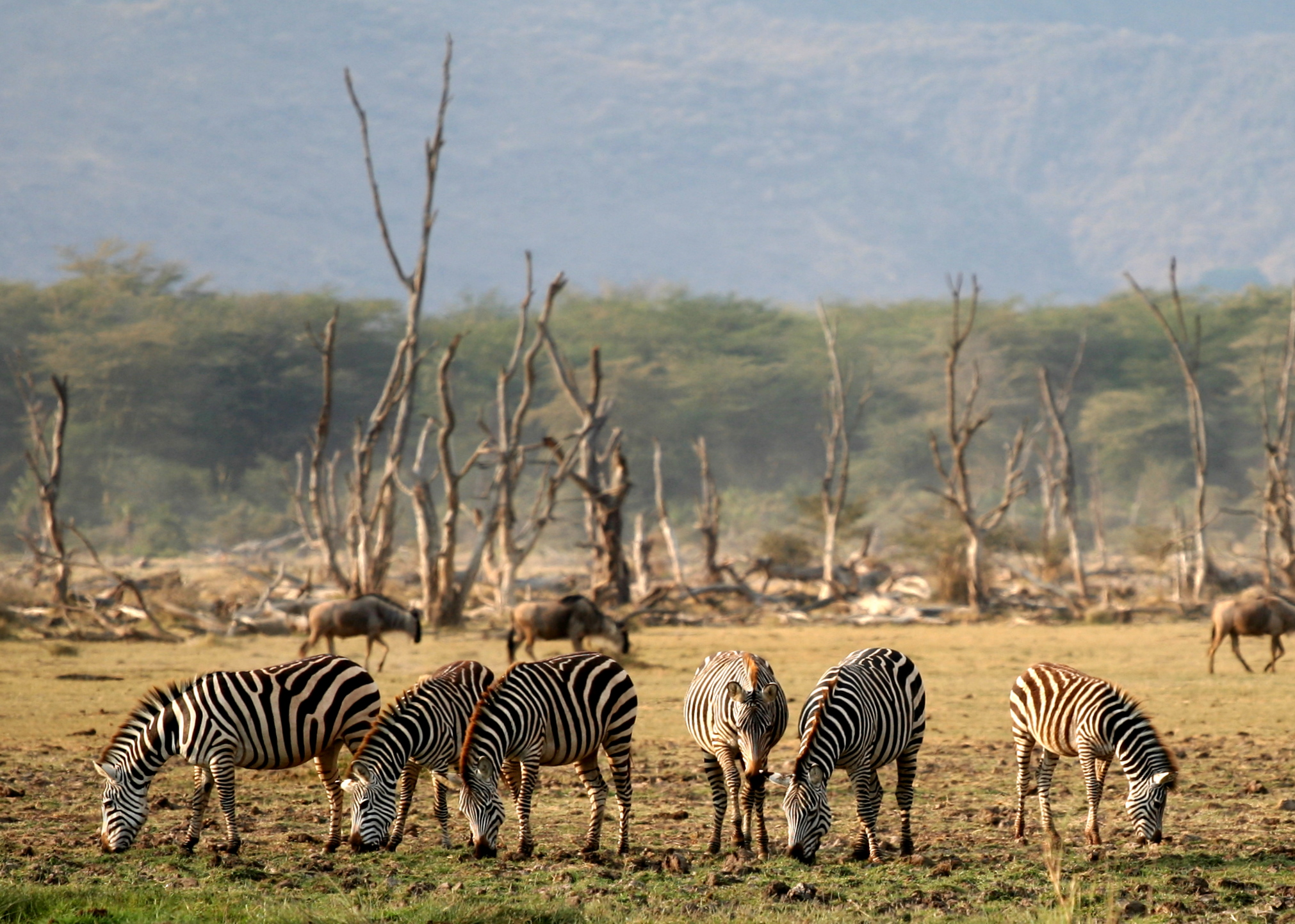
The Lake Manyara National Parkis perfect for a full day (or even a long morning), especially if you're moving between Arusha and Ngorongoro.
A well-rounded day usually feels like this:
Morning: forest and primates
Start with green. The groundwater forest is where the “Manyara factor” is most noticeable: huge groups of baboons, monkeys moving along the headland and a gentle entrance to the safari.
The idea of “going slowly” also fits here: you don't have to go 40 km/h looking for a lion at any price. Many scenes happen a few meters from the vehicle.
Lunch: riverbank and clearings
When you leave the forest, Manyara opens. Clarions appear, more open areas and views of the lake. It is a good time to stop, hydrate and “read the landscape”: where there is water, where birds are concentrated, where herbivores move.
And beware of the little ones: sometimes the best memory is not a big cat, but a dik-dik on Lake Manyaracrossing at full speed and leaving you with a face of “has this really happened?”.
Afternoon: lake, hot springs and last sighting
TANAPA mentions as a geological feature the hot water springs(thermal springs) within the park experience. It is not a spa, of course, but it adds a different point to the typical game driveand reinforces that idea of a “varied” park.
If your goal is birds, the afternoon can be very good on banks and wetlands, with more movement and activity.
Ready to explore Lake Manyara on a full northern circuit?
Our Tanzania Classic Safari takes you through the best of the northern circuit, including parks like Manyara, in just 6 days. 6 days, from 2.095 € per person. Tanzania - Classic Safari
Manyara or Tarangire: the most common duel (and how to choose without dramas)
The question Manyara of Tarangirealways comes out because both stay close and compete for days on the itinerary. The good choice is not “which one is better”, but “which one fits your style”.
Here is a useful comparison:
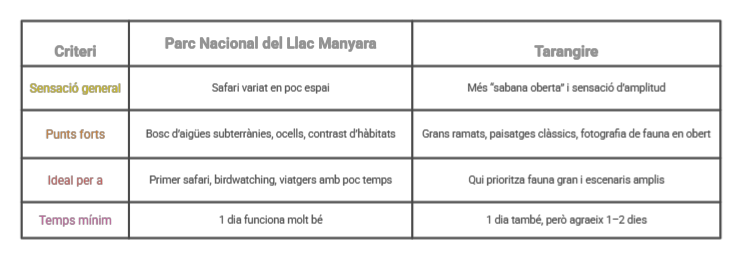
My recommendation for profiles:
- “I want diversity and a different experience”: Lake Manyara National Park.
- “I want more flat safari feeling and big scenes”: Tarangire.
- “I have 2 days” - combine both and do not choose. Your future self will thank you.
How to get there: Arusha, Ngorongoro, Tarangire and Eyasi (distances that really matter)
On the northern circuit, distances are not measured only in kilometers, but in road pace, stops and a desire to improvise.
Arusha → Manyara
The typical query is Distanța Arusha, Manyara. As an orientation, the road trip usually takes around 2, 3 hours, depending on the exact point of departure, traffic and stops. If you also stay near the escarpment, there are references that place the Mto wa Mbu/Manyara area about 2.5 hours from Arusha by road. This makes Arusha and Manyara a very comfortable combination.
Manyara → Ngorongoro
The other big question is Distance from Manyara to Ngorongoro. In practice, it is a usual route jump: you leave Manyara, go up to the Karatu area and continue towards the conservation area. Counting several hours is normal, and he assumes that the landscape invites you to stop.
Tarangire ↔ Manyara
There is also a lot of search for distance from Tarangire to Manyara. They're relatively close within the northern circuit, but the actual plan depends on how you structure your day: if you do morning safari on one, don't expect to get to the other and squeeze it out equally in the afternoon.
Manyara → Lake Eyasi (by 4x4)
If you are thinking of “getting out of the script”, the question arises of the 4x4 distance from Manyara to Lake Eyasi. It is an interesting extension if you want local culture and different landscapes. Here the 4x4 and the condition of the tracks matter much more than the exact number of kilometers.
Can you fly to Manyara?
Yes: Lake Manyara Airport exists (code LKY), which is used as a gateway to this area.
However, the operational (direct, stopover, flight days) changes according to season and airline, so the smart move is to look at options also via Arusha/Kilimanjaro.
Where to sleep: panoramic options vs practical camps
In Manyara, broadly speaking, there are two clear styles depending on what you prioritize:
Option 1: Panoramic accommodation at height
They are often in the escarpment or in areas with views, meant to arrive, shower, dine well and sleep like a functional person (not like a safari zombie). They ask you if you value:
- Views and feeling of “refuge” after the park day
- Comfort without complicating
- Good base to connect route the next day
Option 2: camps and functional accommodation
For tighter budgets or if you prefer something simple, there are camps and lodgespractical. Here my advice is to look at it with a magnifying glass:
- Real location. If it is too far from the entrance (gate), you lose safari time.
- Noise and logistics. Generators, silent hours, common areas, etc.
- What's included. Meals, water, mosquito net, private or shared bathroom, and if there is electricity all night.
Quick rule: On safari, sleeping “a little better” is almost always an investment in energy. There is no need for luxury, but rest.
Weather in Lake Manyara: dry season, rains and expectations
People are looking for the weather in Lake Manyarabecause he wants to square two things: sighting and comfort.
In general, thedry season on Lake Manyara(usually from June to October) usually facilitates observation: less dense vegetation and more concentration of fauna near water points.
What about the rainy season? It has its charm:
- Greener landscape
- Lots of bird activity
- Less dust (your lungs and your camera celebrate it)
The counterpart, without deceiving us: with more vegetation, some animals may be more “hidden”, but the park looks more alive and photogenic.
Tickets & Reservations: Lake Manyara National Park Online
If you are going on your own (or just want to understand how it works), you are interested in this: the Lake Manyara National Park onlineexists in the sense that TANAPA has an online reservation and payment system that operators and agents use to manage tickets before going to the park.
What does this mean for you, as a traveler?
- If you go with an agency, they should have it managed.
- If you organize part of the trip on your own, ask how they process tickets and permits.
- In high season, planning avoids last-minute scares.

Quick checklist to enjoy Manyara as it deserves
Before leaving:
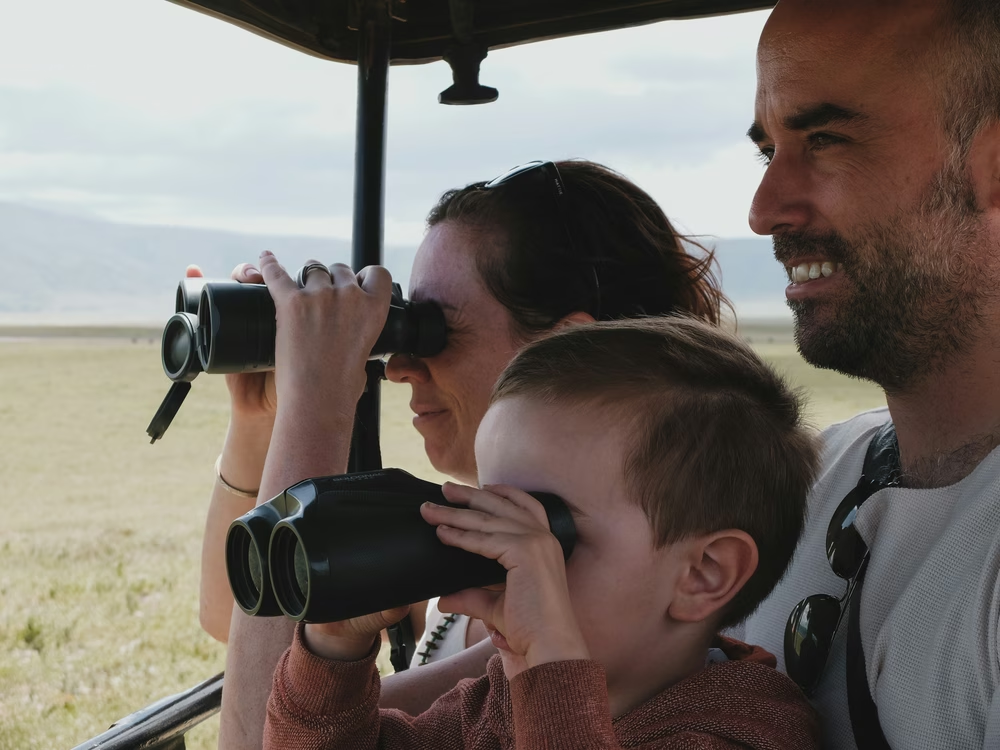
- Binoculars (if you like birds, this changes your trip)
- Repellent and lightweight long sleeve for sunset
- Power bank(photos + video = goodbye battery)
- Cap, sunscreen and glasses
- Bag for the camera and a cloth (dust and moisture take their toll)
During the safari:
- Prioritize first and last hours
- Don't chase “the perfect list”: Manyara enjoys scenes
- Water at hand and patience: the best moments are not forced
If you are going to do extra activities (walks, canopy, etc.):
- Confirm duration and requirements
- Closed shoes
- And zero expectations of “seeing everything”: here the one who watches the most wins, not the one who runs the most
Conclusion: why Manyara works (even if you have a few days)
The Lake Manyarait is a park that surprises because it does not look like a single thing: it is lake, forest and savannah in a concentrated format. If what excites you is the contrast (and yes, that touch of pink when flamingos appear), the Lake Manyara National Parkis a very solid bet within the northern circuit.
My final advice? If you hesitate between “add Manyara” or “skip it”, think about what you are missing on the route. If you lack variety, birds and a safari that is lived differently, the Lake Manyara National ParkHe gives it to you.
FAQs about Lake Manyara
Where is Lake Manyara located within the northern circuit of Tanzania?
Between Arusha and Ngorongoro, at the base of the Rift Valley, as a very logical route stop.
Are there flamingos all year round on Lake Manyara?
Not always in the same amount. Their presence varies according to lake conditions and movements between wetlands.
How long does it take from Arusha to Lake Manyara?
As an orientation, it is usually a journey of about 2, 3 hours by road, depending on stops and traffic.
What is the “underwater forest” of Manyara?
It is a forest fed by underground waters/springs, very green and dense, which contrasts with the savannah and the lake area.
Manyara or Tarangire for a first safari?
Manyara if you want variety and birds; Tarangire if you prioritize open savannah and great scenes.
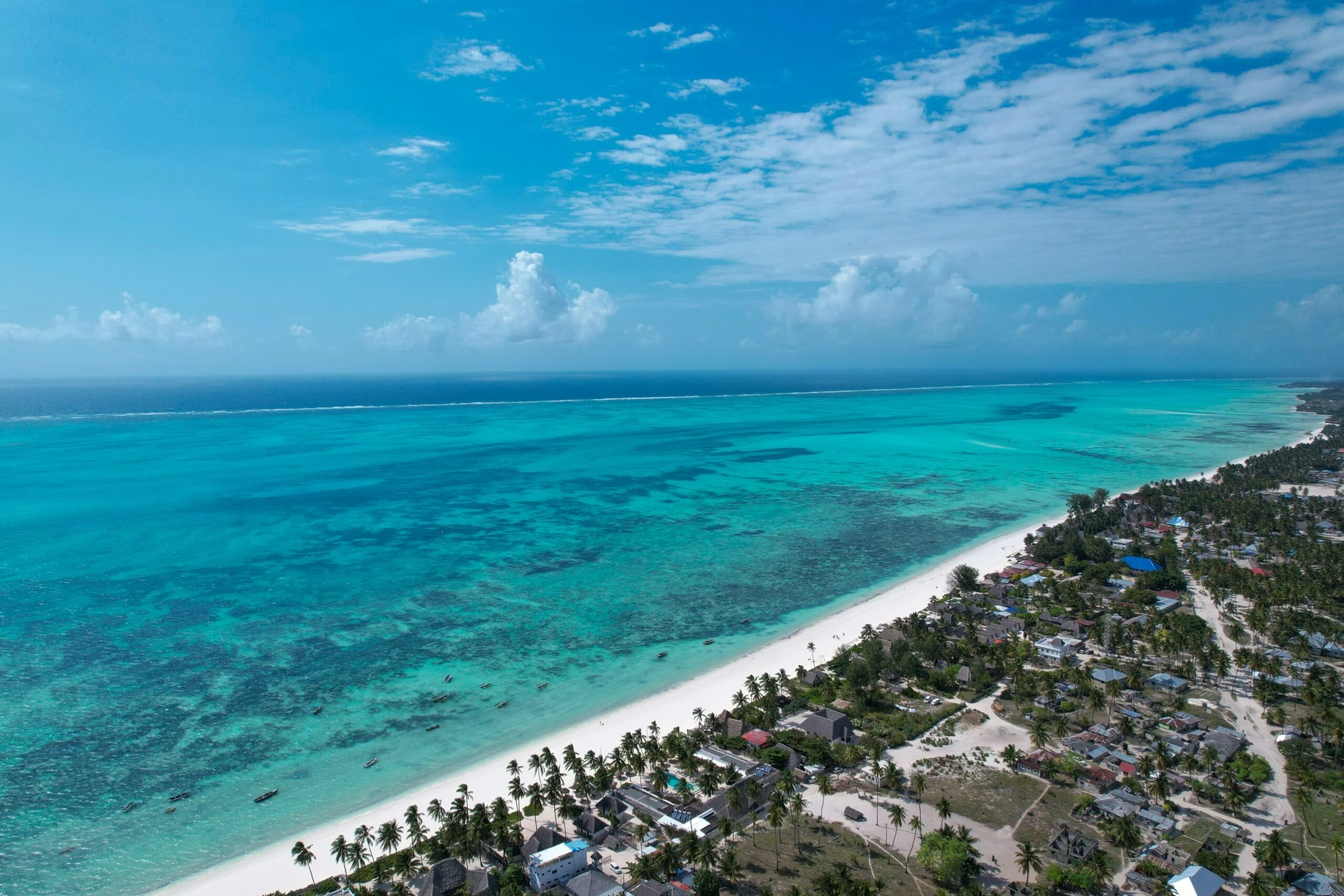
How to organize tours from Zanzibar to Manyara?
With internal flight (for example to LKYor via Arusha/Kilimanjaro) and an agency detailing what's included, timetables and realistic logistics.
Make Lake Manyara part of your Tanzania adventure
From the flamingo shores to the groundwater forest, our Tanzania routes are designed to make the most of every hour in the field. 8 days, from 2.850 € per person. Tanzania - Origine
Frequently asked questions
Where is Lake Manyara located within the northern circuit of Tanzania?
Lake Manyara sits at the base of the Great Rift Valley escarpment, roughly between Arusha and the Ngorongoro Conservation Area. It is one of the most logical first stops on the classic northern circuit, making it easy to combine with Ngorongoro and the Serengeti without backtracking.
Are flamingos guaranteed at Lake Manyara all year round?
Flamingos are not guaranteed in the same numbers throughout the year. Their presence depends on water levels, salinity and food availability. Concentrations can be spectacular at certain times, turning the shoreline pink, but they move freely between wetlands. Check recent sighting reports before your visit to manage expectations.
What is the famous 'underwater forest' of Lake Manyara?
The term refers to the groundwater forest fed by springs rising beneath the Rift escarpment. It is not a submerged forest but a lush, dense woodland that thrives against all odds in a semi-arid landscape. Walking or driving through it feels like entering a green tunnel, full of baboons, monkeys and birds.
How long does the drive from Arusha to Lake Manyara take?
The road journey from Arusha to Lake Manyara National Park typically takes around 2 to 3 hours, depending on your exact starting point, traffic conditions and any stops along the way. The road is generally in good condition and is travelled regularly as part of northern circuit itineraries.
Should I choose Manyara or Tarangire for a first safari?
Both parks are excellent but suit different preferences. Lake Manyara offers habitat diversity (lake, forest and savannah), outstanding birdwatching and a compact experience. Tarangire is better known for large elephant herds and open savannah scenery. If you have two days, combining both is the most rewarding option.
When is the best time to visit Lake Manyara National Park?
The dry season (roughly June to October) offers easier wildlife sightings as vegetation thins and animals gather near water. The rainy season brings lush green landscapes, reduced dust and exceptional birdlife. Both periods have real appeal; the best time depends on whether you prioritise game viewing or photographic scenery.
If you are preparing a route through northern Tanzania and want a “compact” but full safari flavor park, Lake ManyaraIt's one of those names that come up over and over again. And not just for the flamingos: the big script twist here is an impossible-looking forest, green and dense, fed by groundwater in the middle of the Rift Valley.
In this post I tell you what to see in the Lake Manyara, how to plan a round day in Lake Manyara National Park, when it makes sense to go there (and when not), and how it fits into eternal doubt: Manyara of Tarangire.
Where Lake Manyara is located (and why it is “understood” at a glance)
When someone asks Where is Lake Manyara, the short answer is: in northern Tanzania, at the base of the Great Rift Valley escarpment, between Arusha and Ngorongoro, within the classic northern circuit.
If you think of it as a “mind map,” the Lake Manyara in TanzaniaIt follows a very logical line:
- Arusha (usual entry point)
- Manyara (park + lake)
- Ngorongoro Conservation Area
- Serengeti (if it continues to rise)
It's the kind of place you end up Googling like “map of Africa: Lake Manyara” because, really, grace is how it connects destinations. Or to put it another way: the Lake Manyara in Africait is not an “isolated park”, it is a piece that fits perfectly into an itinerary.
The “underwater forest” of Manyara: what it is and why it is interesting
Manyara is often described as a miniature habitat park. In a few kilometers you pass from the shore of an alkaline lake to plains and suddenly you enter a humid forest that looks like from another country.
This contrast has a very specific culprit: a Groundwater forest(floodplain), fed by springs and water that emerges under the Rift escarpment. TANAPA mentions it as one of the traits that sustain a lot of life, especially primates, and UNESCO also highlights these perennial outcrops that sustain the forest.
Does this “underwater forest” mean that you will see trees under water? Not exactly. The idea is this:
- It is not a submerged forest like in a marine documentary.
- It is a forest that lives “against all logic”, thanks to groundwater and waterled/riparian areas.
- The result: shade, freshness and unusual plant density in a savannah environment.
Visiting tip: when you enter this forest, look up and not just the path. It is where the experience changes: sounds, light, hidden birds, groups of baboons... and that feeling of “I am inside a green tunnel”.
Flamingos on Lake Manyara (and the rest of the cast that doesn't make headlines)
Let's go with the star: Lake Manyaraand “flamingos” have become almost synonymous. And yes, the lake can concentrate huge amounts at specific times, to the point of dyeing the shore pink. TANAPA even mentions very high flamenco counts in specific episodes.
But here is the nuance that avoids disappointments: flamingos move. The level of water, salinity and the availability of food mean that there are seasons with too many and others with less. The experience is real, only it doesn't work like “there's always X”.
Fast birdwatching: herons, raptors and “that day the aufrany comes out”
If you like bird watching, Manyara is a very grateful park. In addition to flamingos, it is easy to find scenes of Sheep in Lake Manyaraon banks and wetlands, and raptors hovering near the escarpment.
And if you are one of those looking for specific species (or have caught yourself typing strange searches), yes: there are people who come here for queries like “aufrany lakac.manyara”. The grace of Manyara is that, by habitat, it can give you surprises: waterfowl in the lake, foresters in the forest and raptors in the transitions.
Photographic mini-tip: for flamingos, prioritize first and last hours for soft light. In the forest, climb the ISO without fear: the shadow rules.
Safari in Lake Manyara National Park: what to see in 1 day (without running like a buffalo is chasing you)
The Lake Manyara National Parkis perfect for a full day (or even a long morning), especially if you're moving between Arusha and Ngorongoro.
A well-rounded day usually feels like this:
Morning: forest and primates
Start with green. The groundwater forest is where the “Manyara factor” is most noticeable: huge groups of baboons, monkeys moving along the headland and a gentle entrance to the safari.
The idea of “going slowly” also fits here: you don't have to go 40 km/h looking for a lion at any price. Many scenes happen a few meters from the vehicle.
Lunch: riverbank and clearings
When you leave the forest, Manyara opens. Clarions appear, more open areas and views of the lake. It is a good time to stop, hydrate and “read the landscape”: where there is water, where birds are concentrated, where herbivores move.
And beware of the little ones: sometimes the best memory is not a big cat, but a dik-dik on Lake Manyaracrossing at full speed and leaving you with a face of “has this really happened?”.
Afternoon: lake, hot springs and last sighting
TANAPA mentions as a geological feature the hot water springs(thermal springs) within the park experience. It is not a spa, of course, but it adds a different point to the typical game driveand reinforces that idea of a “varied” park.
If your goal is birds, the afternoon can be very good on banks and wetlands, with more movement and activity.
Ready to explore Lake Manyara on a full northern circuit?
Our Tanzania Classic Safari takes you through the best of the northern circuit, including parks like Manyara, in just 6 days. 6 days, from 2.095 € per person. Tanzania - Classic Safari
Manyara or Tarangire: the most common duel (and how to choose without dramas)
The question Manyara of Tarangirealways comes out because both stay close and compete for days on the itinerary. The good choice is not “which one is better”, but “which one fits your style”.
Here is a useful comparison:
My recommendation for profiles:
- “I want diversity and a different experience”: Lake Manyara National Park.
- “I want more flat safari feeling and big scenes”: Tarangire.
- “I have 2 days” - combine both and do not choose. Your future self will thank you.
How to get there: Arusha, Ngorongoro, Tarangire and Eyasi (distances that really matter)
On the northern circuit, distances are not measured only in kilometers, but in road pace, stops and a desire to improvise.
Arusha → Manyara
The typical query is Distanța Arusha, Manyara. As an orientation, the road trip usually takes around 2, 3 hours, depending on the exact point of departure, traffic and stops. If you also stay near the escarpment, there are references that place the Mto wa Mbu/Manyara area about 2.5 hours from Arusha by road. This makes Arusha and Manyara a very comfortable combination.
Manyara → Ngorongoro
The other big question is Distance from Manyara to Ngorongoro. In practice, it is a usual route jump: you leave Manyara, go up to the Karatu area and continue towards the conservation area. Counting several hours is normal, and he assumes that the landscape invites you to stop.
Tarangire ↔ Manyara
There is also a lot of search for distance from Tarangire to Manyara. They're relatively close within the northern circuit, but the actual plan depends on how you structure your day: if you do morning safari on one, don't expect to get to the other and squeeze it out equally in the afternoon.
Manyara → Lake Eyasi (by 4x4)
If you are thinking of “getting out of the script”, the question arises of the 4x4 distance from Manyara to Lake Eyasi. It is an interesting extension if you want local culture and different landscapes. Here the 4x4 and the condition of the tracks matter much more than the exact number of kilometers.
Can you fly to Manyara?
Yes: Lake Manyara Airport exists (code LKY), which is used as a gateway to this area.
However, the operational (direct, stopover, flight days) changes according to season and airline, so the smart move is to look at options also via Arusha/Kilimanjaro.
Where to sleep: panoramic options vs practical camps
In Manyara, broadly speaking, there are two clear styles depending on what you prioritize:
Option 1: Panoramic accommodation at height
They are often in the escarpment or in areas with views, meant to arrive, shower, dine well and sleep like a functional person (not like a safari zombie). They ask you if you value:
- Views and feeling of “refuge” after the park day
- Comfort without complicating
- Good base to connect route the next day
Option 2: camps and functional accommodation
For tighter budgets or if you prefer something simple, there are camps and lodgespractical. Here my advice is to look at it with a magnifying glass:
- Real location. If it is too far from the entrance (gate), you lose safari time.
- Noise and logistics. Generators, silent hours, common areas, etc.
- What's included. Meals, water, mosquito net, private or shared bathroom, and if there is electricity all night.
Quick rule: On safari, sleeping “a little better” is almost always an investment in energy. There is no need for luxury, but rest.
Weather in Lake Manyara: dry season, rains and expectations
People are looking for the weather in Lake Manyarabecause he wants to square two things: sighting and comfort.
In general, thedry season on Lake Manyara(usually from June to October) usually facilitates observation: less dense vegetation and more concentration of fauna near water points.
What about the rainy season? It has its charm:
- Greener landscape
- Lots of bird activity
- Less dust (your lungs and your camera celebrate it)
The counterpart, without deceiving us: with more vegetation, some animals may be more “hidden”, but the park looks more alive and photogenic.
Tickets & Reservations: Lake Manyara National Park Online
If you are going on your own (or just want to understand how it works), you are interested in this: the Lake Manyara National Park onlineexists in the sense that TANAPA has an online reservation and payment system that operators and agents use to manage tickets before going to the park.
What does this mean for you, as a traveler?
- If you go with an agency, they should have it managed.
- If you organize part of the trip on your own, ask how they process tickets and permits.
- In high season, planning avoids last-minute scares.
Quick checklist to enjoy Manyara as it deserves
Before leaving:
- Binoculars (if you like birds, this changes your trip)
- Repellent and lightweight long sleeve for sunset
- Power bank(photos + video = goodbye battery)
- Cap, sunscreen and glasses
- Bag for the camera and a cloth (dust and moisture take their toll)
During the safari:
- Prioritize first and last hours
- Don't chase “the perfect list”: Manyara enjoys scenes
- Water at hand and patience: the best moments are not forced
If you are going to do extra activities (walks, canopy, etc.):
- Confirm duration and requirements
- Closed shoes
- And zero expectations of “seeing everything”: here the one who watches the most wins, not the one who runs the most
Conclusion: why Manyara works (even if you have a few days)
The Lake Manyarait is a park that surprises because it does not look like a single thing: it is lake, forest and savannah in a concentrated format. If what excites you is the contrast (and yes, that touch of pink when flamingos appear), the Lake Manyara National Parkis a very solid bet within the northern circuit.
My final advice? If you hesitate between “add Manyara” or “skip it”, think about what you are missing on the route. If you lack variety, birds and a safari that is lived differently, the Lake Manyara National ParkHe gives it to you.
FAQs about Lake Manyara
Where is Lake Manyara located within the northern circuit of Tanzania?
Between Arusha and Ngorongoro, at the base of the Rift Valley, as a very logical route stop.
Are there flamingos all year round on Lake Manyara?
Not always in the same amount. Their presence varies according to lake conditions and movements between wetlands.
How long does it take from Arusha to Lake Manyara?
As an orientation, it is usually a journey of about 2, 3 hours by road, depending on stops and traffic.
What is the “underwater forest” of Manyara?
It is a forest fed by underground waters/springs, very green and dense, which contrasts with the savannah and the lake area.
Manyara or Tarangire for a first safari?
Manyara if you want variety and birds; Tarangire if you prioritize open savannah and great scenes.
How to organize tours from Zanzibar to Manyara?
With internal flight (for example to LKYor via Arusha/Kilimanjaro) and an agency detailing what's included, timetables and realistic logistics.
Make Lake Manyara part of your Tanzania adventure
From the flamingo shores to the groundwater forest, our Tanzania routes are designed to make the most of every hour in the field. 8 days, from 2.850 € per person. Tanzania - Origine
Frequently asked questions
Where is Lake Manyara located within the northern circuit of Tanzania?
Lake Manyara sits at the base of the Great Rift Valley escarpment, roughly between Arusha and the Ngorongoro Conservation Area. It is one of the most logical first stops on the classic northern circuit, making it easy to combine with Ngorongoro and the Serengeti without backtracking.
Are flamingos guaranteed at Lake Manyara all year round?
Flamingos are not guaranteed in the same numbers throughout the year. Their presence depends on water levels, salinity and food availability. Concentrations can be spectacular at certain times, turning the shoreline pink, but they move freely between wetlands. Check recent sighting reports before your visit to manage expectations.
What is the famous 'underwater forest' of Lake Manyara?
The term refers to the groundwater forest fed by springs rising beneath the Rift escarpment. It is not a submerged forest but a lush, dense woodland that thrives against all odds in a semi-arid landscape. Walking or driving through it feels like entering a green tunnel, full of baboons, monkeys and birds.
How long does the drive from Arusha to Lake Manyara take?
The road journey from Arusha to Lake Manyara National Park typically takes around 2 to 3 hours, depending on your exact starting point, traffic conditions and any stops along the way. The road is generally in good condition and is travelled regularly as part of northern circuit itineraries.
Should I choose Manyara or Tarangire for a first safari?
Both parks are excellent but suit different preferences. Lake Manyara offers habitat diversity (lake, forest and savannah), outstanding birdwatching and a compact experience. Tarangire is better known for large elephant herds and open savannah scenery. If you have two days, combining both is the most rewarding option.
When is the best time to visit Lake Manyara National Park?
The dry season (roughly June to October) offers easier wildlife sightings as vegetation thins and animals gather near water. The rainy season brings lush green landscapes, reduced dust and exceptional birdlife. Both periods have real appeal; the best time depends on whether you prioritise game viewing or photographic scenery.


.jpeg)

.avif)














.avif)
.avif)


.avif)


.avif)
.avif)


.avif)

.jpeg)










.png)