




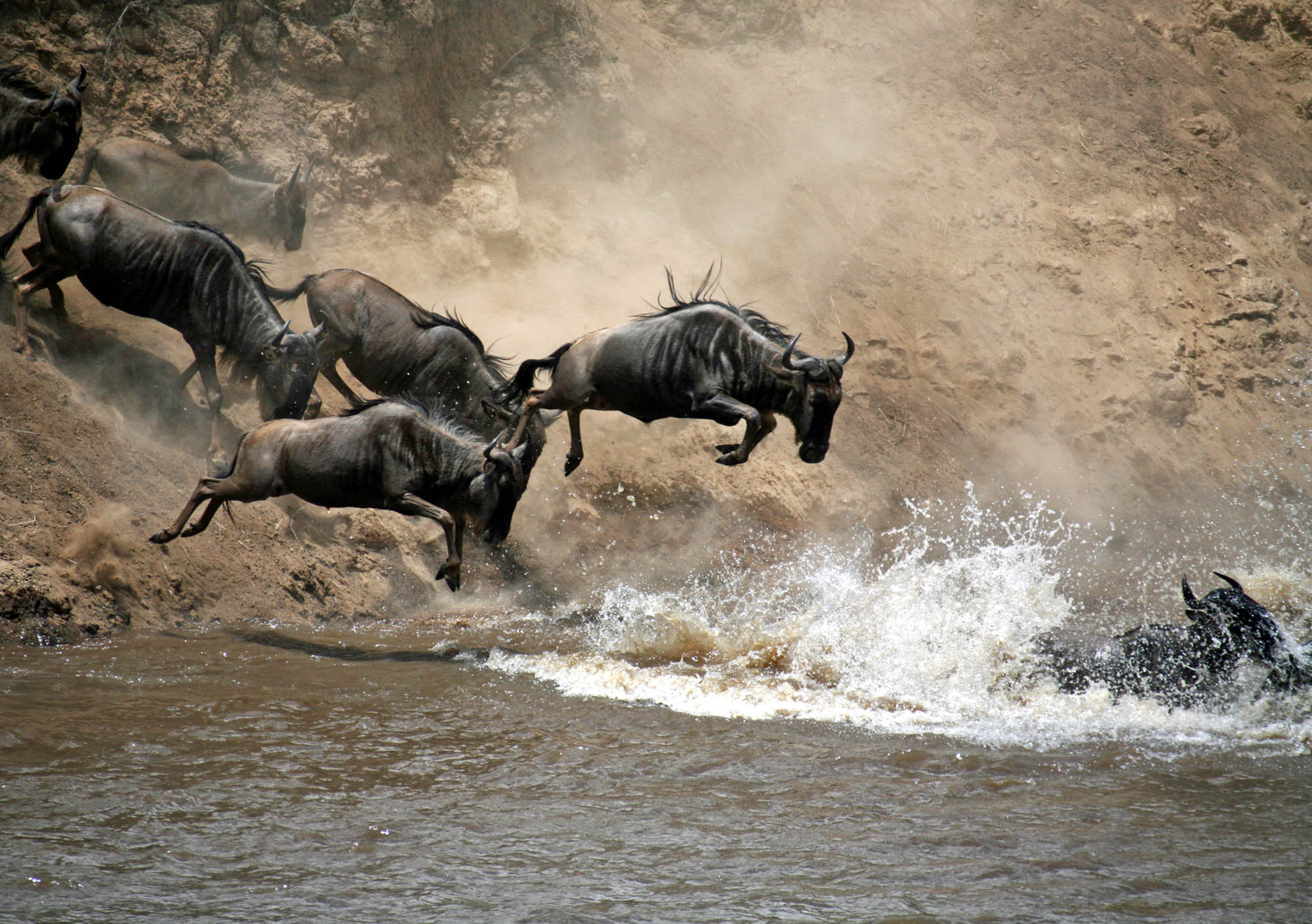

The crossings of the Mara Riverare one of the most shocking scenes of the great African migration. Thousands of nyus and zebras reach the shore, cluster, hesitate, retreat, advance again... and, suddenly, a jump. Then it can be followed by hundreds or thousands of animals in an avalanche of water, dust and tension.
It is the image that many people have in mind when they think of a safari in Africa: animals crossing the Mara River, crocodiles waiting in the water and herds advancing between the Serengeti and the Masai Mara.
But there is one important thing to know from the beginning: the crossing of the Mara River cannot be scheduled. It does not happen at an exact time, or at a fixed point, or every day. You can travel at the best time, sleep near the river and have an excellent guide. Still, nature will decide.
This does not mean that everything depends on luck. There are months, zones and decisions that greatly increase your chances of seeing a nyu crossing the Mara Riveror even large herds crossing it. The key is to understand when to go, where to stay and what to really expect.
What is the Mara River and why is it so famous
The Mara RiverHe is one of the great protagonists of the great migration. Born in Kenya, crosses the ecosystem of Masai MaraIt continues to Tanzania, where it crosses the northern Serengeti.
That is why, when we talk about Mara River in Africa, we are not just talking about a beautiful river in the middle of the savannah. We are talking about a natural barrier that millions of animals have to overcome during their migratory route.
Many searches mix terms such as Mara River Kenya, Mara River Tanzania, Maasai Mara Riveror even “Mara Riu”. They all point to the same idea: the river where some of the most famous moments of the migration of nyus occur.
Its importance is better understood if we visualize the route. Herds move between the Serengeti plains in Tanzania and the Masai Mara in Kenya, following the rains and fresh pastures. On this path, the Mara River becomes an inevitable obstacle.
It's not just water. It is stream, mud, slopes, group pressure, predators and crocodiles. All together. A pretty serious cocktail for any animal that just tries to continue eating grass in peace.
Therefore, see the migration of nyus in the Mara Riverhas become one of the most sought-after experiences for those traveling to Kenya or Tanzania.
What are the crossings of the Mara River
The crossings of the Mara Riverare the times when herds of nyus, zebras and other herbivores cross the river during the great migration.
The scene can be very different depending on the day. Sometimes they cross a few animals. Other times, thousands. At times, herds pile up for hours on the shore, they seem about to jump... and in the end they leave without crossing.
Yes, the savannah also knows how to create suspense.
The reason for the crossing is simple: animals need to continue moving towards new areas of pasture and water. Migration is not an excursion. It is survival.
The problem is that the Mara River can be dangerous. There are deep areas, current, slippery banks, steep descents and crocodiles. That is why animals hesitate so much before launching into it.
When someone talks about Crossing the Mara River, usually refers to this scene: foxes and zebras crossing the water in full migration.
And although the nyus are the best known protagonists, it is also common to see zebras crossing the Mara River. The zebras usually accompany the nests for a good part of the route, because both species benefit from moving in groups and taking advantage of the pastures in a complementary way.

When to see the crossings of the Mara River
The best time to see the crossings of the Mara River is usually from July to October, with a particularly interesting window between August and September.
But it is necessary to insist on one thing: There are no exact dates. Migration depends on rainfall, the state of pastures and the natural movement of herds. Some years come earlier. Others, later. Even during the same month, they may cross at different points of the river or not cross for several days.
The important thing is not to choose “the perfect day”, but to travel within a good window and spend enough nights in the area.
July: first arrivals north of the Serengeti
July usually marks the arrival of many herds to the north of the Serengeti. It is a month of transition, but it can offer very powerful scenes.
At this time, the animals begin to approach the Mara River in Tanzania, especially in areas such as Kogatende and Lamai. There may be crossings, although the concentrations are not always as large as in August or September.
July is a good option if you want to increase your chances without fully entering the peak of the high season.
August: the most searched month
If there is a month associated with the crossing, it is August. A lot of people are looking directly August Mara Riverbecause they want to see the most iconic scene of the great migration.
And it makes sense. August is usually one of the best months to find large herds near the river, both north of the Serengeti and the Masai Mara.
Now: August does not guarantee crossing. It increases the odds, but does not turn nature into a spectacle with an afternoon schedule.
In addition, August is high season. There are more passengers, more vehicles and higher prices. If you want to travel this month, it is advisable to book well in advance.
September: an excellent window
September is another of the best months to see animals crossing the Mara River. Herds may be spread between the northern Serengeti and the Masai Mara, and crossings are still possible.
For many travelers, September offers a very interesting balance: good cruising options, favorable weather and a somewhat less intense experience than August in some areas.
If your priority is to see the Crossing the Mara River, September should be high on your list.
October: Last Chances
October may continue to offer crossings, although migration is starting to be more variable. Some herds remain in the north, while others begin the return to the south of the Serengeti depending on the rains.
It is an interesting month if you are looking for a less crowded experience, but it is not the safest if your only goal is to see a great crossover.
See the crossing with the right route
Our Tanzania migration route puts you in the right place at the right time, with expert guides who read herd behaviour and position you near active crossing points. 9 days, from 3.350 € per person. Tanzania - Crossroads of the Great Migration
Where to see the crossing of the Mara River: Tanzania or Kenya
One of the big questions is where to see the crossing: Tanzania or Kenya?
The answer depends on your itinerary, the dates and the type of safari you are looking for. The Mara River passes through both countries and is part of the same ecosystem, but the experience can change a lot.
Mara River in Tanzania: North of the Serengeti
In Tanzania, crossings are mainly seen in North Serengeti. This area is one of the best to witness the Crossing the Mara River in TanzaniaEspecially between July and October.
Areas such as Kogatende, Lamai and the surroundings of the Mara RiverThese are common places to stay and explore the area.
The great advantage of the North Serengeti is that it offers a very wide and wild experience. The scenery is huge, the distances are great and at times you can feel less concentrated than certain areas of the Masai Mara.
It also allows you to combine the crossing with other stages of the Serengeti, especially if you do a more complete safari through Tanzania.
Mara River in Kenya: Masai Mara
In Kenya, the river flows through the Masai Mara National Reserve and its nearby areas. This area is famous for the high concentration of fauna and for being one of the most popular places to see migration.
The Mara River in Kenyacan offer great scenes between August and September, when many herds arrive at the Masai Mara.
The advantage is that the Masai Mara is more compact than the Serengeti. This can facilitate some sighting. The least attractive part is that, in high season, some points can concentrate quite a lot of vehicles.
So which option is better?
Choose Tanzaniaif you want to live a wider experience in the north of the Serengeti, with more feeling of wild territory and the possibility of combining with other areas of the country.
Choose Kenyaif you have fewer days, you want to focus on the Masai Mara and travel in the middle of the migration season.
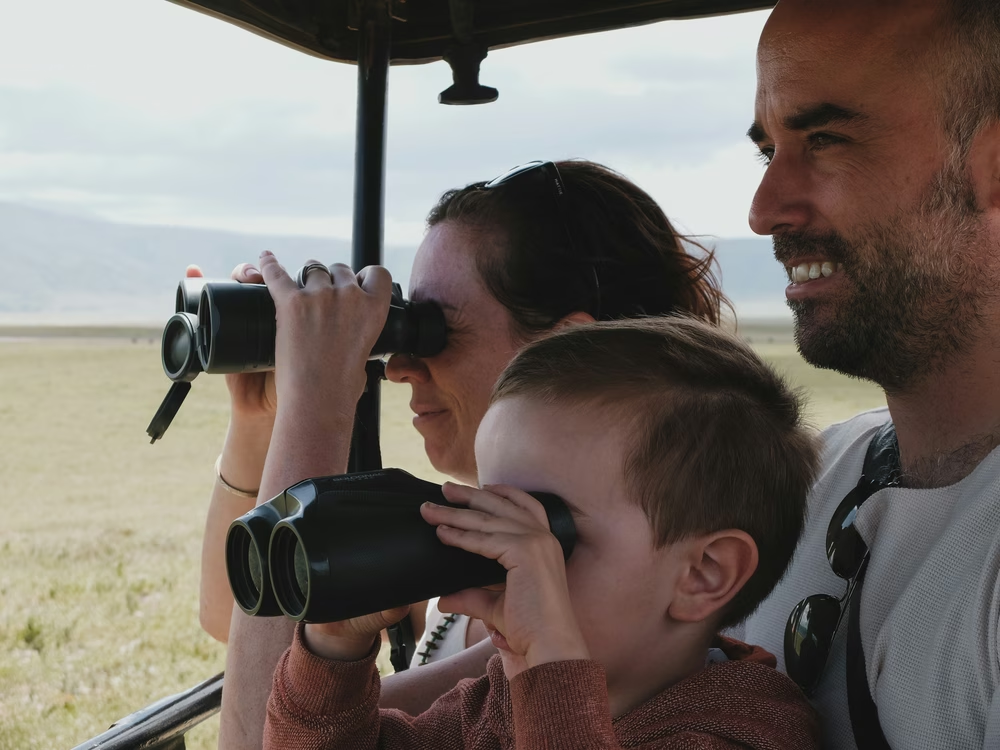
And if you have 12 or 14 days, combining Kenya and Tanzania, 9 days, from 3.350 € per person. Of course: better to do it calmly. Trying to see everything in a hurry usually turns the safari into a move with binoculars.
Quick table: best time and area to see animals crossing the Mara River

This table is a guideline. Migration doesn't work like a school calendar. If you want to see zebras crossing the Mara River, nyus throwing themselves into the water or crocodiles in full action, it is best to spend several nights in the appropriate area.
Characteristics of the Mara River that condition the crossings
The Characteristics of the Mara Riverexplain why the crossings are so tense.
It is not always a huge river, but it can be very difficult to cross. It has points with current, deep areas, steep banks and mud slopes. Depending on the rains, the flow rate can change quite a bit.
Animals don't believe anywhere. They usually approach points where others have already crossed or where the descent seems less dangerous. But even so, they can spend hours doubting.
This behavior is one of the most fascinating parts of crossing. The herds approach, stop, retreat, approach again. Sometimes a noise, a poorly placed vehicle or a sudden movement can cause the whole group to disperse.
Collective pressure is also key. Many times, when a first nyu is launched, the others follow it almost immediately. The individual decision becomes an avalanche.
That's why no two safaris on the Mara River are ever the same. You can be at the same point, the same month, and live completely different experiences.
Crocodiles of the Mara River: the most famous risk
The Crocodiles of the Mara RiverThey are an inseparable part of the imaginary of the great migration. When thinking of the crossing, many people imagine a huge crocodile waiting underwater as the nyus jump from the shore.
And yes, there are crocodiles in the Mara River. Some are great, patient and very opportunistic. During crossings, they can attack exhausted, disoriented or trapped animals in difficult areas.
Searches about River Mara crocodiles, Mara River Crocodile, crocodile river Marao Crocodiles hunting in the Mara RiverThey come from this very powerful image.
But it is advisable not to reduce the whole phenomenon to the attack of crocodiles. Crossing has many other risks.
Some animals are injured when descending too steep banks. Others are exhausted by swimming. In mass crossings, there may be avalanches and thrusts. And upon leaving the water, herds remain exposed to terrestrial predators such as lions or hyenas.
The Crocodiles in the Mara RiverThey are awesome, yes. But they're not bad movies. They are part of the ecosystem. Migration is hard because nature is tough. It does not need dramatic background music, even if the documentaries insist on it.
How to increase the chances of seeing a crossing of the Mara River
Seeing a crossover has a share of luck, but also a lot of strategy.
The first recommendation is clear: spend enough nights in the Mara River area. If you can, book at least 3 nights in the North Serengeti or the Masai Mara during the appropriate season. With just one night, your chances drop a lot.
The second key is accommodation. It is not enough to sleep “in the Serengeti” or “in the Masai Mara”. You must stay near the active migration zone. In Tanzania, this usually means north of the Serengeti. In Kenya, areas well located within or near the Masai Mara.
The third key is to have a good guide. An expert guide knows how to read the behavior of herds, anticipate movements and decide when to wait or when to change points.
It also helps to get out early and be patient. Crossings can happen when you least expect it. Sometimes you spend hours looking at a shore without anything happening. Other times, it all happens in twenty minutes.
Practical tips:
- Travel between July and October.
- Priority August or Septemberif crossing is your big goal.
- Reserve minimum 3 nightsto the area.
- Choose accommodation near the river.
- Travel with expert guides.
- Avoid routes that are too fast.
- Do not turn the trip into an obsession for a single scene.
The safari should not be a distressing pursuit of the crossing. It should be a complete experience. If the crossover arrives, perfect. If you don't arrive, the Serengeti and Masai Mara remain two of the best places on the planet to see wildlife.

Common mistakes when planning a safari on the Mara River
One of the most common mistakes is to think that August guarantees the crossing of the Mara River. August is a great month, but not a guarantee.
Another common mistake is booking accommodation far from the river area. On a map it may seem that everything is close, but in safari the distances are measured differently. Tracks, weather and driving times matter a lot.
It is also common to go there only one night and expect to see the great crossing. It can happen, of course. You can also find parking at the door of a trendy restaurant on a Saturday night. But it is not advisable to base the plan on this.
Another mistake is to confuse Masai Marawith the Mara River. The Masai Mara is a reserve in Kenya. The Mara River is the river that crosses the area and continues towards Tanzania.
It is also worth avoiding the idea that all crossings are huge. Some are small. Others are fast. Some have thousands of animals. Others, only a few dozen.
And finally, don't choose safari just for a viral photo. The Great Migration is much more than a concrete picture.
River Mara map: how to understand the area
When you are looking Mara river map, usually you want to understand where exactly the crossing takes place.
The simplest way to visualize it is this: the Mara River crosses the ecosystem formed by the Serengeti, in Tanzania, and the Masai Mara, Kenya.
To the south of the border is the northern Serengeti. To the north, the Masai Mara. The herds move between the two territories following the rains and the pastures.
The river should not be understood as a simple line on the map, but as a natural axis within a huge ecosystem. Crossings can occur at different points, not always in the same place.
That is why it is so important to choose the base of the safari well. Sleeping in a generic area of the Serengeti is not the same as staying near Kogatende during the cruising season. Nor is it the same to be anywhere in Kenya than to sleep in a well-located area of the Masai Mara.
On a safari on the Mara River, Location changes everything..
FAQ about Mara River Crossings
When is it better to see the crossing of the Mara River?
The best time is usually between July and October, with more possibilities to August and September. Still, crossings depend on rainfall, herd movement, and river conditions.
Where is the crossing of the Mara River better seen, in Tanzania or Kenya?
A Tanzania, the crossings are seen north of the Serengeti. A Kenya, are seen in the Masai Mara. Both options can be excellent. Tanzania usually offers a wider and wilder experience; Kenya can be more compact and accessible if you have fewer days.
Can you guarantee to see nyus crossing the Mara River?
No. No safari can guarantee a crossing. What you can do is increase your options by traveling in good weather, staying near the river and spending several nights in the area.
In August there are always crossings on the Mara River?
August is one of the best months, but it does not guarantee daily crossings. There may be large concentrations of animals and still spend hours or days without them crossing the point where you are.
What animals cross the Mara River?
The main protagonists are nyusbut they can also be seen zebras crossing the Mara River, as well as gazelles and other herbivores. On the banks and in the water also appear predators, including crocodiles, lions and hyenas.
Are there crocodiles in the Mara River?
Yeah. There is Crocodiles in the Mara River, and some can attack during crossings. However, they are not the only risk to animals. Current, banks, depletion and avalanches are also part of the danger.
Conclusion: the crossing of the Mara River is sought, but not scheduled
The crossings of the Mara RiverThis is one of the most impressive moments of the Great Migration. Seeing nyus and zebras throwing themselves into the water, crocodiles waiting and thousands of animals moving forward by pure instinct is an experience hard to forget.
But to live it well you have to travel with realistic expectations. The crossing of the Mara River does not have a fixed schedule. It cannot be reserved or guaranteed. What you can do is choose a good time, stay in the right area and devote enough days to the safari.
If you travel between July and October, especially in August or September, and you are located either in the north of the Serengeti or in the Masai Mara, your options increase a lot.
And if the crossing finally passes in front of you, congratulations: you will have seen one of the wildest and most powerful scenes in Africa.
If it doesn't happen, don't leave empty-handed either. Because on the Mara River, even waiting can be part of the show.
Ready to witness the crossing?
We have itineraries designed around the migration calendar, with accommodation close to the active zones and experienced local guides on hand every day. Tanzania
The crossings of the Mara Riverare one of the most shocking scenes of the great African migration. Thousands of nyus and zebras reach the shore, cluster, hesitate, retreat, advance again... and, suddenly, a jump. Then it can be followed by hundreds or thousands of animals in an avalanche of water, dust and tension.
It is the image that many people have in mind when they think of a safari in Africa: animals crossing the Mara River, crocodiles waiting in the water and herds advancing between the Serengeti and the Masai Mara.
But there is one important thing to know from the beginning: the crossing of the Mara River cannot be scheduled. It does not happen at an exact time, or at a fixed point, or every day. You can travel at the best time, sleep near the river and have an excellent guide. Still, nature will decide.
This does not mean that everything depends on luck. There are months, zones and decisions that greatly increase your chances of seeing a nyu crossing the Mara Riveror even large herds crossing it. The key is to understand when to go, where to stay and what to really expect.
What is the Mara River and why is it so famous
The Mara RiverHe is one of the great protagonists of the great migration. Born in Kenya, crosses the ecosystem of Masai MaraIt continues to Tanzania, where it crosses the northern Serengeti.
That is why, when we talk about Mara River in Africa, we are not just talking about a beautiful river in the middle of the savannah. We are talking about a natural barrier that millions of animals have to overcome during their migratory route.
Many searches mix terms such as Mara River Kenya, Mara River Tanzania, Maasai Mara Riveror even “Mara Riu”. They all point to the same idea: the river where some of the most famous moments of the migration of nyus occur.
Its importance is better understood if we visualize the route. Herds move between the Serengeti plains in Tanzania and the Masai Mara in Kenya, following the rains and fresh pastures. On this path, the Mara River becomes an inevitable obstacle.
It's not just water. It is stream, mud, slopes, group pressure, predators and crocodiles. All together. A pretty serious cocktail for any animal that just tries to continue eating grass in peace.
Therefore, see the migration of nyus in the Mara Riverhas become one of the most sought-after experiences for those traveling to Kenya or Tanzania.
What are the crossings of the Mara River
The crossings of the Mara Riverare the times when herds of nyus, zebras and other herbivores cross the river during the great migration.
The scene can be very different depending on the day. Sometimes they cross a few animals. Other times, thousands. At times, herds pile up for hours on the shore, they seem about to jump... and in the end they leave without crossing.
Yes, the savannah also knows how to create suspense.
The reason for the crossing is simple: animals need to continue moving towards new areas of pasture and water. Migration is not an excursion. It is survival.
The problem is that the Mara River can be dangerous. There are deep areas, current, slippery banks, steep descents and crocodiles. That is why animals hesitate so much before launching into it.
When someone talks about Crossing the Mara River, usually refers to this scene: foxes and zebras crossing the water in full migration.
And although the nyus are the best known protagonists, it is also common to see zebras crossing the Mara River. The zebras usually accompany the nests for a good part of the route, because both species benefit from moving in groups and taking advantage of the pastures in a complementary way.
When to see the crossings of the Mara River
The best time to see the crossings of the Mara River is usually from July to October, with a particularly interesting window between August and September.
But it is necessary to insist on one thing: There are no exact dates. Migration depends on rainfall, the state of pastures and the natural movement of herds. Some years come earlier. Others, later. Even during the same month, they may cross at different points of the river or not cross for several days.
The important thing is not to choose “the perfect day”, but to travel within a good window and spend enough nights in the area.
July: first arrivals north of the Serengeti
July usually marks the arrival of many herds to the north of the Serengeti. It is a month of transition, but it can offer very powerful scenes.
At this time, the animals begin to approach the Mara River in Tanzania, especially in areas such as Kogatende and Lamai. There may be crossings, although the concentrations are not always as large as in August or September.
July is a good option if you want to increase your chances without fully entering the peak of the high season.
August: the most searched month
If there is a month associated with the crossing, it is August. A lot of people are looking directly August Mara Riverbecause they want to see the most iconic scene of the great migration.
And it makes sense. August is usually one of the best months to find large herds near the river, both north of the Serengeti and the Masai Mara.
Now: August does not guarantee crossing. It increases the odds, but does not turn nature into a spectacle with an afternoon schedule.
In addition, August is high season. There are more passengers, more vehicles and higher prices. If you want to travel this month, it is advisable to book well in advance.
September: an excellent window
September is another of the best months to see animals crossing the Mara River. Herds may be spread between the northern Serengeti and the Masai Mara, and crossings are still possible.
For many travelers, September offers a very interesting balance: good cruising options, favorable weather and a somewhat less intense experience than August in some areas.
If your priority is to see the Crossing the Mara River, September should be high on your list.
October: Last Chances
October may continue to offer crossings, although migration is starting to be more variable. Some herds remain in the north, while others begin the return to the south of the Serengeti depending on the rains.
It is an interesting month if you are looking for a less crowded experience, but it is not the safest if your only goal is to see a great crossover.
See the crossing with the right route
Our Tanzania migration route puts you in the right place at the right time, with expert guides who read herd behaviour and position you near active crossing points. 9 days, from 3.350 € per person. Tanzania - Crossroads of the Great Migration
Where to see the crossing of the Mara River: Tanzania or Kenya
One of the big questions is where to see the crossing: Tanzania or Kenya?
The answer depends on your itinerary, the dates and the type of safari you are looking for. The Mara River passes through both countries and is part of the same ecosystem, but the experience can change a lot.
Mara River in Tanzania: North of the Serengeti
In Tanzania, crossings are mainly seen in North Serengeti. This area is one of the best to witness the Crossing the Mara River in TanzaniaEspecially between July and October.
Areas such as Kogatende, Lamai and the surroundings of the Mara RiverThese are common places to stay and explore the area.
The great advantage of the North Serengeti is that it offers a very wide and wild experience. The scenery is huge, the distances are great and at times you can feel less concentrated than certain areas of the Masai Mara.
It also allows you to combine the crossing with other stages of the Serengeti, especially if you do a more complete safari through Tanzania.
Mara River in Kenya: Masai Mara
In Kenya, the river flows through the Masai Mara National Reserve and its nearby areas. This area is famous for the high concentration of fauna and for being one of the most popular places to see migration.
The Mara River in Kenyacan offer great scenes between August and September, when many herds arrive at the Masai Mara.
The advantage is that the Masai Mara is more compact than the Serengeti. This can facilitate some sighting. The least attractive part is that, in high season, some points can concentrate quite a lot of vehicles.
So which option is better?
Choose Tanzaniaif you want to live a wider experience in the north of the Serengeti, with more feeling of wild territory and the possibility of combining with other areas of the country.
Choose Kenyaif you have fewer days, you want to focus on the Masai Mara and travel in the middle of the migration season.
And if you have 12 or 14 days, combining Kenya and Tanzania, 9 days, from 3.350 € per person. Of course: better to do it calmly. Trying to see everything in a hurry usually turns the safari into a move with binoculars.
Quick table: best time and area to see animals crossing the Mara River
This table is a guideline. Migration doesn't work like a school calendar. If you want to see zebras crossing the Mara River, nyus throwing themselves into the water or crocodiles in full action, it is best to spend several nights in the appropriate area.
Characteristics of the Mara River that condition the crossings
The Characteristics of the Mara Riverexplain why the crossings are so tense.
It is not always a huge river, but it can be very difficult to cross. It has points with current, deep areas, steep banks and mud slopes. Depending on the rains, the flow rate can change quite a bit.
Animals don't believe anywhere. They usually approach points where others have already crossed or where the descent seems less dangerous. But even so, they can spend hours doubting.
This behavior is one of the most fascinating parts of crossing. The herds approach, stop, retreat, approach again. Sometimes a noise, a poorly placed vehicle or a sudden movement can cause the whole group to disperse.
Collective pressure is also key. Many times, when a first nyu is launched, the others follow it almost immediately. The individual decision becomes an avalanche.
That's why no two safaris on the Mara River are ever the same. You can be at the same point, the same month, and live completely different experiences.
Crocodiles of the Mara River: the most famous risk
The Crocodiles of the Mara RiverThey are an inseparable part of the imaginary of the great migration. When thinking of the crossing, many people imagine a huge crocodile waiting underwater as the nyus jump from the shore.
And yes, there are crocodiles in the Mara River. Some are great, patient and very opportunistic. During crossings, they can attack exhausted, disoriented or trapped animals in difficult areas.
Searches about River Mara crocodiles, Mara River Crocodile, crocodile river Marao Crocodiles hunting in the Mara RiverThey come from this very powerful image.
But it is advisable not to reduce the whole phenomenon to the attack of crocodiles. Crossing has many other risks.
Some animals are injured when descending too steep banks. Others are exhausted by swimming. In mass crossings, there may be avalanches and thrusts. And upon leaving the water, herds remain exposed to terrestrial predators such as lions or hyenas.
The Crocodiles in the Mara RiverThey are awesome, yes. But they're not bad movies. They are part of the ecosystem. Migration is hard because nature is tough. It does not need dramatic background music, even if the documentaries insist on it.
How to increase the chances of seeing a crossing of the Mara River
Seeing a crossover has a share of luck, but also a lot of strategy.
The first recommendation is clear: spend enough nights in the Mara River area. If you can, book at least 3 nights in the North Serengeti or the Masai Mara during the appropriate season. With just one night, your chances drop a lot.
The second key is accommodation. It is not enough to sleep “in the Serengeti” or “in the Masai Mara”. You must stay near the active migration zone. In Tanzania, this usually means north of the Serengeti. In Kenya, areas well located within or near the Masai Mara.
The third key is to have a good guide. An expert guide knows how to read the behavior of herds, anticipate movements and decide when to wait or when to change points.
It also helps to get out early and be patient. Crossings can happen when you least expect it. Sometimes you spend hours looking at a shore without anything happening. Other times, it all happens in twenty minutes.
Practical tips:
- Travel between July and October.
- Priority August or Septemberif crossing is your big goal.
- Reserve minimum 3 nightsto the area.
- Choose accommodation near the river.
- Travel with expert guides.
- Avoid routes that are too fast.
- Do not turn the trip into an obsession for a single scene.
The safari should not be a distressing pursuit of the crossing. It should be a complete experience. If the crossover arrives, perfect. If you don't arrive, the Serengeti and Masai Mara remain two of the best places on the planet to see wildlife.
Common mistakes when planning a safari on the Mara River
One of the most common mistakes is to think that August guarantees the crossing of the Mara River. August is a great month, but not a guarantee.
Another common mistake is booking accommodation far from the river area. On a map it may seem that everything is close, but in safari the distances are measured differently. Tracks, weather and driving times matter a lot.
It is also common to go there only one night and expect to see the great crossing. It can happen, of course. You can also find parking at the door of a trendy restaurant on a Saturday night. But it is not advisable to base the plan on this.
Another mistake is to confuse Masai Marawith the Mara River. The Masai Mara is a reserve in Kenya. The Mara River is the river that crosses the area and continues towards Tanzania.
It is also worth avoiding the idea that all crossings are huge. Some are small. Others are fast. Some have thousands of animals. Others, only a few dozen.
And finally, don't choose safari just for a viral photo. The Great Migration is much more than a concrete picture.
River Mara map: how to understand the area
When you are looking Mara river map, usually you want to understand where exactly the crossing takes place.
The simplest way to visualize it is this: the Mara River crosses the ecosystem formed by the Serengeti, in Tanzania, and the Masai Mara, Kenya.
To the south of the border is the northern Serengeti. To the north, the Masai Mara. The herds move between the two territories following the rains and the pastures.
The river should not be understood as a simple line on the map, but as a natural axis within a huge ecosystem. Crossings can occur at different points, not always in the same place.
That is why it is so important to choose the base of the safari well. Sleeping in a generic area of the Serengeti is not the same as staying near Kogatende during the cruising season. Nor is it the same to be anywhere in Kenya than to sleep in a well-located area of the Masai Mara.
On a safari on the Mara River, Location changes everything..
FAQ about Mara River Crossings
When is it better to see the crossing of the Mara River?
The best time is usually between July and October, with more possibilities to August and September. Still, crossings depend on rainfall, herd movement, and river conditions.
Where is the crossing of the Mara River better seen, in Tanzania or Kenya?
A Tanzania, the crossings are seen north of the Serengeti. A Kenya, are seen in the Masai Mara. Both options can be excellent. Tanzania usually offers a wider and wilder experience; Kenya can be more compact and accessible if you have fewer days.
Can you guarantee to see nyus crossing the Mara River?
No. No safari can guarantee a crossing. What you can do is increase your options by traveling in good weather, staying near the river and spending several nights in the area.
In August there are always crossings on the Mara River?
August is one of the best months, but it does not guarantee daily crossings. There may be large concentrations of animals and still spend hours or days without them crossing the point where you are.
What animals cross the Mara River?
The main protagonists are nyusbut they can also be seen zebras crossing the Mara River, as well as gazelles and other herbivores. On the banks and in the water also appear predators, including crocodiles, lions and hyenas.
Are there crocodiles in the Mara River?
Yeah. There is Crocodiles in the Mara River, and some can attack during crossings. However, they are not the only risk to animals. Current, banks, depletion and avalanches are also part of the danger.
Conclusion: the crossing of the Mara River is sought, but not scheduled
The crossings of the Mara RiverThis is one of the most impressive moments of the Great Migration. Seeing nyus and zebras throwing themselves into the water, crocodiles waiting and thousands of animals moving forward by pure instinct is an experience hard to forget.
But to live it well you have to travel with realistic expectations. The crossing of the Mara River does not have a fixed schedule. It cannot be reserved or guaranteed. What you can do is choose a good time, stay in the right area and devote enough days to the safari.
If you travel between July and October, especially in August or September, and you are located either in the north of the Serengeti or in the Masai Mara, your options increase a lot.
And if the crossing finally passes in front of you, congratulations: you will have seen one of the wildest and most powerful scenes in Africa.
If it doesn't happen, don't leave empty-handed either. Because on the Mara River, even waiting can be part of the show.
Ready to witness the crossing?
We have itineraries designed around the migration calendar, with accommodation close to the active zones and experienced local guides on hand every day. Tanzania









.avif)



.avif)




.avif)


.avif)

.avif)
.avif)

.avif)

.jpeg)










.png)