




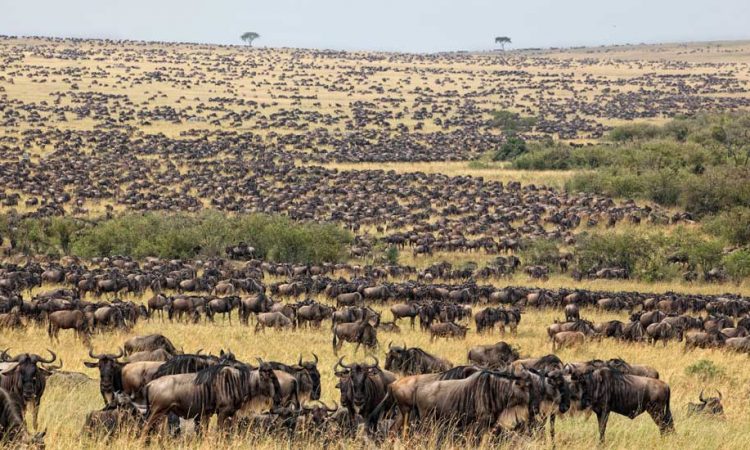

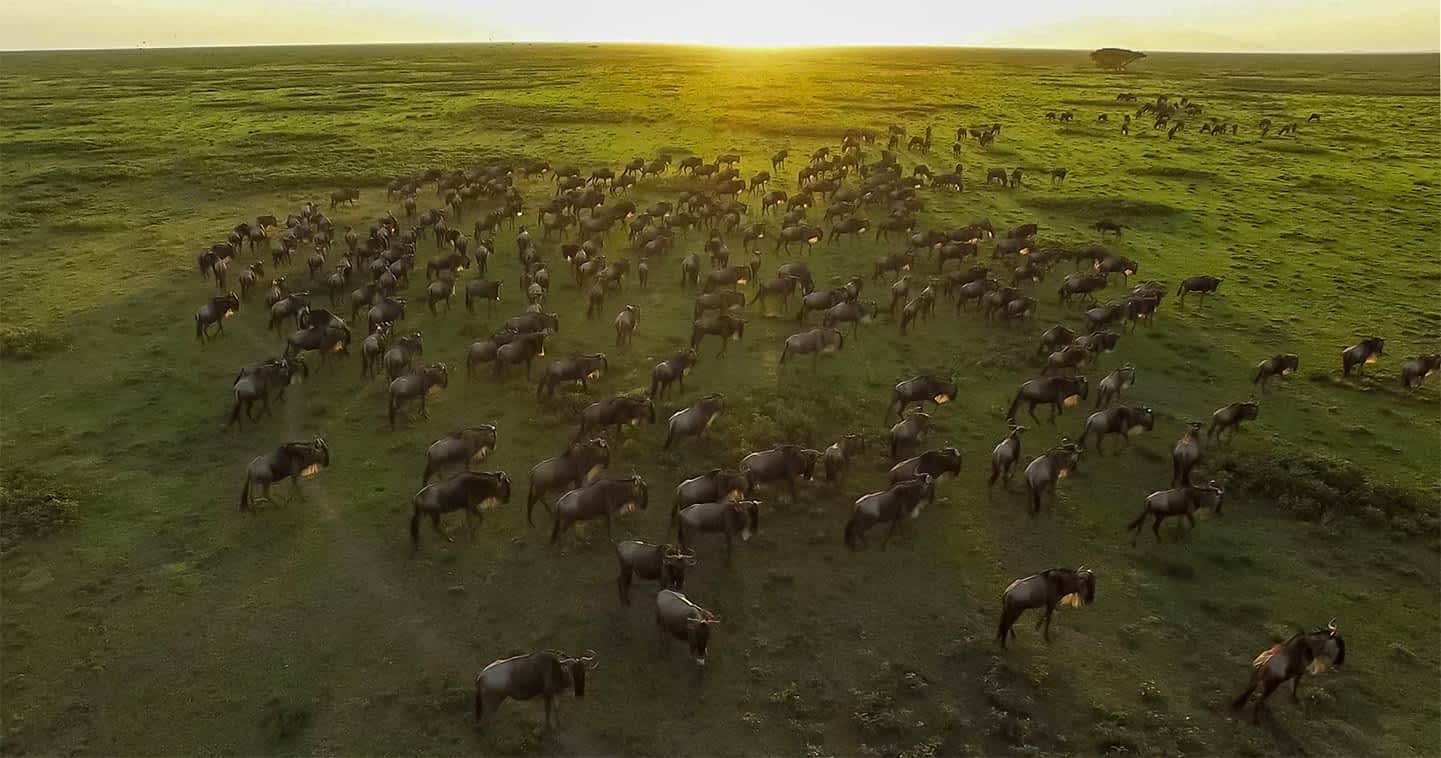
The great migration in the Serengeti is one of those natural spectacles that are worth experiencing at least once in a lifetime. It happens every year, in East Africa, with more than a million nyus advancing along the plains with zebras, gazelles and predators that do not lose detail.
However, there is one key idea that needs to be clear from the beginning: the great migration does not happen on an exact date or in a single place. It is not a festival with posters, schedules and food trucks. It is a natural cycle marked by rains, pastures and the instinct of survival.
Therefore, if you are thinking of traveling to Tanzania to see the great migration of the Serengeti, the correct question is not only “when to go”, but Where to be at every moment of the year.
In this guide you will find a clear explanation, month by month, to know when the great migration in Tanzania is, which areas of the Serengeti should be chosen and how to plan a safari with realistic expectations.
What is the Serengeti Great Migration
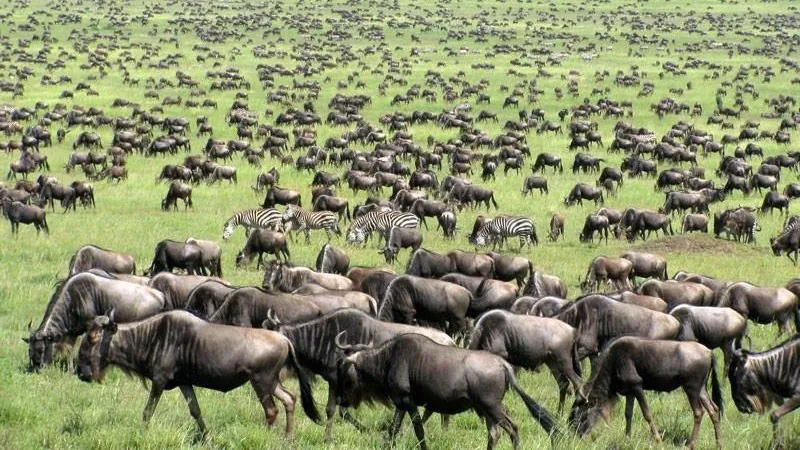
The Great Migration is the circular movement of huge herds of herbivores between the Serengeti, in Tanzania, and the Masai Mara, in Kenya. The main protagonists are the nyus, although they travel accompanied by thousands of zebras and gazelles.
This movement does not happen on a whim. Animals follow the rains in search of fresh pastures and water. When one area begins to dry out, the herds move to a more fertile one. Thus, year after year, they complete a route that crosses plains, rivers, open forests and savannah areas.
The Great African Migration is famous for several iconic moments: the mass births south of the Serengeti, the crossings of rivers such as the Grumeti or the Mara, and the constant tension between prey and predators. Lions, hyenas, cheetahs, leopards and crocodiles are part of this wild balance.
When we talk about Great migration Tanzania, we usually refer to the stages that take place within the Serengeti ecosystem. And when you mention the Great migration Kenya Tanzania, speaks of the complete cycle, including the passage to the Masai Mara.
The key is to understand that there is not a single “big picture” of migration. There are a lot of them. A safari in February can show births and predators in action. One in August can take you north to the Serengeti and the famous crossing of the Mara River. One in November may coincide with the return of the herds to the south.
They are all the great migrations. It just changes the scene.
When is the Great Migration in Tanzania
The most honest answer is this: the great migration in Tanzania happens all year roundBut not always in the same area.
The Serengeti is huge. So saying “I'm going to the Serengeti to see migration” is a good start, but it's not enough. The most important thing is to know in which area of the park the herds are likely to be found during your trip.
The schedule may vary depending on the rains. Some years the herds advance. Others are late. Still, there is a pretty useful pattern to plan for.
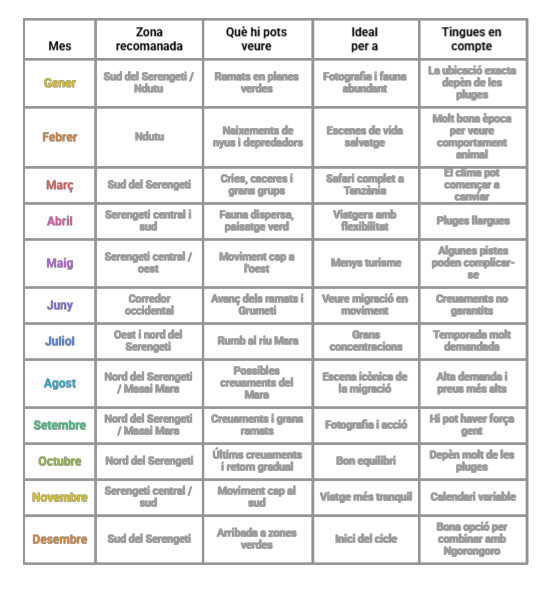
January to March: Southern Serengeti and Ndutu
Between January and March, the great migration is usually concentrated in the southern Serengeti and in the Ndutu area, near the Ngorongoro Conservation Area.
It is one of the most interesting times to see migration in Tanzania. The plains are green, there is abundant food and the breeding season of the nyuses occurs. Thousands of young are born in a few weeks, which makes the area a stage full of life.
It is also an intense time to observe predators. Newborn cubs attract lions, hyenas, cheetahs and jackals. It may sound harsh, but it is part of the natural cycle. Savannah does not sweeten anything.
This stage is ideal for those who want to see animal behavior, hunting scenes and large herds in open landscapes.
See the births in Ndutu for yourself
Our 8-day route covers the southern Serengeti and Ndutu during calving season, giving you the best chance of witnessing this incredible natural spectacle. 8 days, from 2.750 € per person. Tanzania - The Breeding of the Great Migration
April and May: long rains and scattered migration
April and May coincide with the long rainy season in Tanzania. The landscape is spectacular: green, lively and with less dust. They also tend to have fewer passengers.
The less comfortable part is that some tracks may be more complicated and the migration may be more scattered. This does not mean that wildlife cannot be seen, far from it. The Serengeti is still impressive. But if your only goal is to find large concentrations of nyus, these months require more flexibility.
For travelers looking for fewer people, tighter prices and a quieter experience, it can be a good option. For those who dream of very specific scenes of the great migration, it is worth considering other dates.
June and July: Western Corridor and Grumeti River
Starting in June, herds usually advance towards the western corridor of the Serengeti. At this stage crossings of the Grumeti River can occur, one of the most sought-after scenes of the great migration of the nyu.
The Grumeti does not always have the visual drama of the Mara River, but it offers very powerful moments. The herds group, hesitate, advance, retreat, and finally cross. Crocodiles can be found in the water. On the ground, predators remain vigilant.
June and July are very interesting months because they combine movement, large concentrations of animals and a clear feeling of traveling on the go. Migration begins to move north.
July to October: North Serengeti and Mara River
Between July and October comes one of the most famous stages: the north of the Serengeti and the crossings of the Mara River.
This is the image that many people have in mind when looking for “the great Serengeti migration”: thousands of nests piled up on the shore, tension in the air and a chaotic crossing in which each animal tries to reach the other side.
But here it is worth lowering the epic volume a little. The crossing of the Mara is not guaranteed. You can be in the right area and the herds don't cross that day. Or they can cross right when you're at another point. Nature has this wonderful and frustrating point: it does not accept reservations.
However, if you want to increase your options, it is best to spend several nights in the north of the Serengeti or in areas close to the Mara River. Going there for a single day “to see the crossing” is like buying a ticket and demanding that the universe behave well.
November and December: Return to the South
With the short rains, the herds begin to move again to the south of the Serengeti. The cycle begins again.
November and December can be very attractive months to travel. There is movement, the landscape begins to green and there is not always as much tourist pressure as in the middle of the crossing season.
It is a good time for those looking for a complete safari, with the possibility of seeing migration, but without obsessing only with the Mara River.
Quick table: where to see the great migration month by month
Serengeti or Masai Mara: where to see it
A common doubt is whether it is better to see the great migration to Tanzania or Kenya. The answer depends on the month, the budget and the type of trip you are looking for.
The Serengeti offers a wider experience. It is huge, diverse and allows you to see different phases of migration: births to the south, movement to the west, crossings to the north and return to the plains. If your idea is to understand the full cycle of the great African migration, Tanzania is a very powerful option.
The Masai Mara, in Kenya, stands out especially between July and October, when herds cross or concentrate in this area. It is smaller than the Serengeti, which can facilitate some sighting, although it also tends to involve more vehicles in high season.
When to choose Tanzania
Choose Tanzania if you want to focus on the Serengeti, live a more extensive safari and have access to various stages of migration depending on the season.
It is also a great choice if you travel between January and March to see births in Ndutu. This phase does not occur in Kenya, but in the south of the Serengeti ecosystem.
When to choose Kenya
Kenya can be a good option if you are traveling between July and October and want to concentrate on the Masai Mara. It is especially interesting for shorter trips, as the distances can be more manageable depending on the itinerary.
Of course, in high season it is advisable to book in advance and assume that you will not be alone. The great migration attracts travelers from all over the world. The nyus do not sell tickets, but almost.
When to combine Kenya and Tanzania
Combining both countries makes sense if you have more days, usually from 12 or 14. It allows you to enjoy the Serengeti, the Masai Mara and other parks or complementary reserves.
For a 7-day trip, it is usually better to choose an area well and not waste too much time on transfers. For a longer trip, combining Kenya and Tanzania can be a spectacular experience.
The Great Moments of the Great Migration
Although the great migration is a continuous cycle, there are several stages that concentrate much of the traveler interest.
Births in Ndutu
Between January and March, the Ndutu area becomes an immense wild nursery. Thousands of nyus are born in a short time, which increases the chances of seeing tender, tense and very dynamic scenes.
It is an excellent time for photographers and wildlife lovers. The open plains allow good visibility and the landscape tends to be green. In addition, the presence of young attracts predators, so the safari can be very active.
Crossing the Grumeti River
The Grumeti, in the western corridor of the Serengeti, usually gains prominence between June and July. It is a less mediatic stage than the Mara, but very interesting.
The herds are moving north and large concentrations of lynxes and zebras can be seen. The crossings are not always massive or predictable, but the area has a special charm and can offer intense scenes.
Crossing the Mara River
The crossing of the Mara is the great icon of the great migration of the Serengeti. Thousands of animals flock to the shore, hesitate for hours or even days, and suddenly one is thrown into the water. The rest can follow him in an impressive avalanche.
It is a powerful scene, but it should not be made the only reason for the trip. You can be lucky and see her on the first day. Or you can spend three days in the area and not witness any crossings. The safari should be enjoyed in its entirety, not just live for a moment.
The Return to the South
After the season in the north, the herds gradually return to the south following the rains. This stage is not so famous, but it is essential to understand migration as a cycle.
The move to the south again prepares for the season of births. The wheel turns again.
How to plan a safari to see the great migration
To see the great migration in Tanzania, planning is very important. It is not enough to book “a safari in the Serengeti” and cross your fingers.
The first decision is the date. Then, the area. And then, the number of nights.
If you travel in February, the priority should be Ndutu or the southern Serengeti. northern Serengeti or combine with the Masai Mara, 9 days, from 3.350 € per person If you travel in June, the western corridor can make a lot of sense.
Accommodation is also key. Being in or near the active migration zone can make a huge difference. If you sleep too far away, you will spend many hours on transfers and less time observing wildlife.
As a rule of thumb, if your main goal is the big migration, book at least 3 nights in the key area of the moment. If you only spend one night, your options go down a lot. Nature does not work with check-in and check-out.
It is also important to have good guides. An expert guide interprets footprints, movements of other vehicles, behavior of herds and changes in the weather. This can completely transform the experience.
Practical tips:
- Do not try to cover the entire Serengeti in a few days.
- Choose the area according to the month, not according to a photo seen on the internet.
- Book in advance if you travel between July and October.
- Maintain some flexibility in the itinerary.
- It assumes that river crossings cannot be guaranteed.
- It values the entire safari more than a single scene.
A good safari of the great migration does not consist of chasing nyus as if they were a pending notification. It consists of being in the right place, with enough time, and letting the savannah do its job.
Common mistakes when looking for the great migration
One of the most common mistakes is to think that the great migration only happens in August. August can be excellent for the northern Serengeti and the Mara River, yes. But migration is active throughout the year.
Another common mistake is to believe that the crossing of the Mara is guaranteed. It is not. You can increase your options by traveling in good weather and sleeping close to the right area, but never insure it one hundred percent.
It is also common to confuse the northern Serengeti with the Masai Mara. They are connected within the same ecosystem, but belong to different countries. The Serengeti is in Tanzania; the Masai Mara is in Kenya.
Another important mistake is choosing accommodation without looking at its location. A lovely lodge can be a bad idea if it is far from the area where the herds move during your trip.
And finally, it is advisable to avoid routes that are too fast. Changing accommodation every night may seem efficient on paper, but in practice it tires and reduces the options for enjoying each area.
Great migration rewards patience. And it also punishes the rush a little.
Checklist to prepare your trip
Before booking your safari to see the great migration of the Serengeti, check these points:
- Define the month of the trip.
- Choose the right area of the Serengeti for that time.
- Book at least 3 nights in the key area if migration is your priority.
- Find out if the Serengeti should be combined with Ngorongoro, Tarangire or Masai Mara.
- It prioritizes expert guides in fauna and migratory behavior.
- Reserve with margin in high season.
- It has binoculars and a camera with a good battery.
- Prepare comfortable clothes, neutral colors and layers for temperature changes.
- Take out appropriate travel insurance.
- Travel with realistic expectations: you will see nature, not a programmed function.
This last point is the most important. The great migration is not controlled. It is interpreted, waited and enjoyed.
FAQ on the Great Migration in the Serengeti
When is the Great Migration in Tanzania?
The great migration in Tanzania occurs throughout the year, but changes zones according to the season. Between January and March it usually concentrates in Ndutu and the south of the Serengeti. Between June and July it advances towards the western corridor. Between July and October it moves through the northern Serengeti and the Mara River area. In November and December it returns to the south.
What is the best month to see the Serengeti Great Migration?
It depends on what you want to see. February is excellent for births in Ndutu. June and July are good for seeing westward movement and possible crossings of the Grumeti. August and September are usually the most sought-after months to try to see crossings of the Mara River north of the Serengeti.
Where is the great migration seen best, in Tanzania or Kenya?
Tanzania allows to see more phases of the migratory cycle within the Serengeti. Kenya, especially the Masai Mara, is very popular between July and October, when herds can cross or concentrate there. If you have few days, it is advisable to choose according to the month. If you have more time, combining Kenya and Tanzania can be a great option.
Can you guarantee to see the crossing of the Mara River?
No. The crossing of the Mara River depends on the behavior of the herds, the flow of the river, the pressure of the environment and many natural factors. You can be in the right area and not see it. That is why it is recommended to spend several nights in the north of the Serengeti or in the Masai Mara during the correct season.
What animals participate in the great African migration?
The protagonists are the nyus, accompanied by zebras and gazelles. Also part of the show are predators that follow the herds, such as lions, hyenas, cheetahs, leopards and crocodiles in rivers.
How many days do I need for a great migration safari?
For a safari focused on the great migration, the ideal is to dedicate at least 3 nights in the area where the herds are at that time. A full trip to Tanzania usually works best with 7 to 10 days, combining the Serengeti with other parks or areas such as the Ngorongoro.
Conclusion: the Great Migration is not a date, it is a cycle
The Great Migration in the Serengeti is one of the biggest wildlife shows on the planet. But to really enjoy it you have to understand it well: it does not happen in a single day, nor in a single point on the map.
In Tanzania you can experience different faces of migration depending on the month: births in Ndutu, large moving herds, river crossings, predators lurking and landscapes that change with the rains.
The best strategy is simple: choose the time, adjust the safari area and travel with enough time. This increases your chances of seeing the great migration and, above all, enjoying the Serengeti without turning the trip into a chase against time.
Because, in the end, the savannah always has the last word. And he usually knows how to tell stories better than any calendar.
Ready to plan your great migration safari?
Our Tanzania migration route is designed around the real movement of the herds, with expert guides and the right camps in the right places at the right time. 9 days, from 3.350 € per person. Tanzania - Crossroads of the Great Migration
The great migration in the Serengeti is one of those natural spectacles that are worth experiencing at least once in a lifetime. It happens every year, in East Africa, with more than a million nyus advancing along the plains with zebras, gazelles and predators that do not lose detail.
However, there is one key idea that needs to be clear from the beginning: the great migration does not happen on an exact date or in a single place. It is not a festival with posters, schedules and food trucks. It is a natural cycle marked by rains, pastures and the instinct of survival.
Therefore, if you are thinking of traveling to Tanzania to see the great migration of the Serengeti, the correct question is not only “when to go”, but Where to be at every moment of the year.
In this guide you will find a clear explanation, month by month, to know when the great migration in Tanzania is, which areas of the Serengeti should be chosen and how to plan a safari with realistic expectations.
What is the Serengeti Great Migration
The Great Migration is the circular movement of huge herds of herbivores between the Serengeti, in Tanzania, and the Masai Mara, in Kenya. The main protagonists are the nyus, although they travel accompanied by thousands of zebras and gazelles.
This movement does not happen on a whim. Animals follow the rains in search of fresh pastures and water. When one area begins to dry out, the herds move to a more fertile one. Thus, year after year, they complete a route that crosses plains, rivers, open forests and savannah areas.
The Great African Migration is famous for several iconic moments: the mass births south of the Serengeti, the crossings of rivers such as the Grumeti or the Mara, and the constant tension between prey and predators. Lions, hyenas, cheetahs, leopards and crocodiles are part of this wild balance.
When we talk about Great migration Tanzania, we usually refer to the stages that take place within the Serengeti ecosystem. And when you mention the Great migration Kenya Tanzania, speaks of the complete cycle, including the passage to the Masai Mara.
The key is to understand that there is not a single “big picture” of migration. There are a lot of them. A safari in February can show births and predators in action. One in August can take you north to the Serengeti and the famous crossing of the Mara River. One in November may coincide with the return of the herds to the south.
They are all the great migrations. It just changes the scene.
When is the Great Migration in Tanzania
The most honest answer is this: the great migration in Tanzania happens all year roundBut not always in the same area.
The Serengeti is huge. So saying “I'm going to the Serengeti to see migration” is a good start, but it's not enough. The most important thing is to know in which area of the park the herds are likely to be found during your trip.
The schedule may vary depending on the rains. Some years the herds advance. Others are late. Still, there is a pretty useful pattern to plan for.
January to March: Southern Serengeti and Ndutu
Between January and March, the great migration is usually concentrated in the southern Serengeti and in the Ndutu area, near the Ngorongoro Conservation Area.
It is one of the most interesting times to see migration in Tanzania. The plains are green, there is abundant food and the breeding season of the nyuses occurs. Thousands of young are born in a few weeks, which makes the area a stage full of life.
It is also an intense time to observe predators. Newborn cubs attract lions, hyenas, cheetahs and jackals. It may sound harsh, but it is part of the natural cycle. Savannah does not sweeten anything.
This stage is ideal for those who want to see animal behavior, hunting scenes and large herds in open landscapes.
See the births in Ndutu for yourself
Our 8-day route covers the southern Serengeti and Ndutu during calving season, giving you the best chance of witnessing this incredible natural spectacle. 8 days, from 2.750 € per person. Tanzania - The Breeding of the Great Migration
April and May: long rains and scattered migration
April and May coincide with the long rainy season in Tanzania. The landscape is spectacular: green, lively and with less dust. They also tend to have fewer passengers.
The less comfortable part is that some tracks may be more complicated and the migration may be more scattered. This does not mean that wildlife cannot be seen, far from it. The Serengeti is still impressive. But if your only goal is to find large concentrations of nyus, these months require more flexibility.
For travelers looking for fewer people, tighter prices and a quieter experience, it can be a good option. For those who dream of very specific scenes of the great migration, it is worth considering other dates.
June and July: Western Corridor and Grumeti River
Starting in June, herds usually advance towards the western corridor of the Serengeti. At this stage crossings of the Grumeti River can occur, one of the most sought-after scenes of the great migration of the nyu.
The Grumeti does not always have the visual drama of the Mara River, but it offers very powerful moments. The herds group, hesitate, advance, retreat, and finally cross. Crocodiles can be found in the water. On the ground, predators remain vigilant.
June and July are very interesting months because they combine movement, large concentrations of animals and a clear feeling of traveling on the go. Migration begins to move north.
July to October: North Serengeti and Mara River
Between July and October comes one of the most famous stages: the north of the Serengeti and the crossings of the Mara River.
This is the image that many people have in mind when looking for “the great Serengeti migration”: thousands of nests piled up on the shore, tension in the air and a chaotic crossing in which each animal tries to reach the other side.
But here it is worth lowering the epic volume a little. The crossing of the Mara is not guaranteed. You can be in the right area and the herds don't cross that day. Or they can cross right when you're at another point. Nature has this wonderful and frustrating point: it does not accept reservations.
However, if you want to increase your options, it is best to spend several nights in the north of the Serengeti or in areas close to the Mara River. Going there for a single day “to see the crossing” is like buying a ticket and demanding that the universe behave well.
November and December: Return to the South
With the short rains, the herds begin to move again to the south of the Serengeti. The cycle begins again.
November and December can be very attractive months to travel. There is movement, the landscape begins to green and there is not always as much tourist pressure as in the middle of the crossing season.
It is a good time for those looking for a complete safari, with the possibility of seeing migration, but without obsessing only with the Mara River.
Quick table: where to see the great migration month by month
Serengeti or Masai Mara: where to see it
A common doubt is whether it is better to see the great migration to Tanzania or Kenya. The answer depends on the month, the budget and the type of trip you are looking for.
The Serengeti offers a wider experience. It is huge, diverse and allows you to see different phases of migration: births to the south, movement to the west, crossings to the north and return to the plains. If your idea is to understand the full cycle of the great African migration, Tanzania is a very powerful option.
The Masai Mara, in Kenya, stands out especially between July and October, when herds cross or concentrate in this area. It is smaller than the Serengeti, which can facilitate some sighting, although it also tends to involve more vehicles in high season.
When to choose Tanzania
Choose Tanzania if you want to focus on the Serengeti, live a more extensive safari and have access to various stages of migration depending on the season.
It is also a great choice if you travel between January and March to see births in Ndutu. This phase does not occur in Kenya, but in the south of the Serengeti ecosystem.
When to choose Kenya
Kenya can be a good option if you are traveling between July and October and want to concentrate on the Masai Mara. It is especially interesting for shorter trips, as the distances can be more manageable depending on the itinerary.
Of course, in high season it is advisable to book in advance and assume that you will not be alone. The great migration attracts travelers from all over the world. The nyus do not sell tickets, but almost.
When to combine Kenya and Tanzania
Combining both countries makes sense if you have more days, usually from 12 or 14. It allows you to enjoy the Serengeti, the Masai Mara and other parks or complementary reserves.
For a 7-day trip, it is usually better to choose an area well and not waste too much time on transfers. For a longer trip, combining Kenya and Tanzania can be a spectacular experience.
The Great Moments of the Great Migration
Although the great migration is a continuous cycle, there are several stages that concentrate much of the traveler interest.
Births in Ndutu
Between January and March, the Ndutu area becomes an immense wild nursery. Thousands of nyus are born in a short time, which increases the chances of seeing tender, tense and very dynamic scenes.
It is an excellent time for photographers and wildlife lovers. The open plains allow good visibility and the landscape tends to be green. In addition, the presence of young attracts predators, so the safari can be very active.
Crossing the Grumeti River
The Grumeti, in the western corridor of the Serengeti, usually gains prominence between June and July. It is a less mediatic stage than the Mara, but very interesting.
The herds are moving north and large concentrations of lynxes and zebras can be seen. The crossings are not always massive or predictable, but the area has a special charm and can offer intense scenes.
Crossing the Mara River
The crossing of the Mara is the great icon of the great migration of the Serengeti. Thousands of animals flock to the shore, hesitate for hours or even days, and suddenly one is thrown into the water. The rest can follow him in an impressive avalanche.
It is a powerful scene, but it should not be made the only reason for the trip. You can be lucky and see her on the first day. Or you can spend three days in the area and not witness any crossings. The safari should be enjoyed in its entirety, not just live for a moment.
The Return to the South
After the season in the north, the herds gradually return to the south following the rains. This stage is not so famous, but it is essential to understand migration as a cycle.
The move to the south again prepares for the season of births. The wheel turns again.
How to plan a safari to see the great migration
To see the great migration in Tanzania, planning is very important. It is not enough to book “a safari in the Serengeti” and cross your fingers.
The first decision is the date. Then, the area. And then, the number of nights.
If you travel in February, the priority should be Ndutu or the southern Serengeti. northern Serengeti or combine with the Masai Mara, 9 days, from 3.350 € per person If you travel in June, the western corridor can make a lot of sense.
Accommodation is also key. Being in or near the active migration zone can make a huge difference. If you sleep too far away, you will spend many hours on transfers and less time observing wildlife.
As a rule of thumb, if your main goal is the big migration, book at least 3 nights in the key area of the moment. If you only spend one night, your options go down a lot. Nature does not work with check-in and check-out.
It is also important to have good guides. An expert guide interprets footprints, movements of other vehicles, behavior of herds and changes in the weather. This can completely transform the experience.
Practical tips:
- Do not try to cover the entire Serengeti in a few days.
- Choose the area according to the month, not according to a photo seen on the internet.
- Book in advance if you travel between July and October.
- Maintain some flexibility in the itinerary.
- It assumes that river crossings cannot be guaranteed.
- It values the entire safari more than a single scene.
A good safari of the great migration does not consist of chasing nyus as if they were a pending notification. It consists of being in the right place, with enough time, and letting the savannah do its job.
Common mistakes when looking for the great migration
One of the most common mistakes is to think that the great migration only happens in August. August can be excellent for the northern Serengeti and the Mara River, yes. But migration is active throughout the year.
Another common mistake is to believe that the crossing of the Mara is guaranteed. It is not. You can increase your options by traveling in good weather and sleeping close to the right area, but never insure it one hundred percent.
It is also common to confuse the northern Serengeti with the Masai Mara. They are connected within the same ecosystem, but belong to different countries. The Serengeti is in Tanzania; the Masai Mara is in Kenya.
Another important mistake is choosing accommodation without looking at its location. A lovely lodge can be a bad idea if it is far from the area where the herds move during your trip.
And finally, it is advisable to avoid routes that are too fast. Changing accommodation every night may seem efficient on paper, but in practice it tires and reduces the options for enjoying each area.
Great migration rewards patience. And it also punishes the rush a little.
Checklist to prepare your trip
Before booking your safari to see the great migration of the Serengeti, check these points:
- Define the month of the trip.
- Choose the right area of the Serengeti for that time.
- Book at least 3 nights in the key area if migration is your priority.
- Find out if the Serengeti should be combined with Ngorongoro, Tarangire or Masai Mara.
- It prioritizes expert guides in fauna and migratory behavior.
- Reserve with margin in high season.
- It has binoculars and a camera with a good battery.
- Prepare comfortable clothes, neutral colors and layers for temperature changes.
- Take out appropriate travel insurance.
- Travel with realistic expectations: you will see nature, not a programmed function.
This last point is the most important. The great migration is not controlled. It is interpreted, waited and enjoyed.
FAQ on the Great Migration in the Serengeti
When is the Great Migration in Tanzania?
The great migration in Tanzania occurs throughout the year, but changes zones according to the season. Between January and March it usually concentrates in Ndutu and the south of the Serengeti. Between June and July it advances towards the western corridor. Between July and October it moves through the northern Serengeti and the Mara River area. In November and December it returns to the south.
What is the best month to see the Serengeti Great Migration?
It depends on what you want to see. February is excellent for births in Ndutu. June and July are good for seeing westward movement and possible crossings of the Grumeti. August and September are usually the most sought-after months to try to see crossings of the Mara River north of the Serengeti.
Where is the great migration seen best, in Tanzania or Kenya?
Tanzania allows to see more phases of the migratory cycle within the Serengeti. Kenya, especially the Masai Mara, is very popular between July and October, when herds can cross or concentrate there. If you have few days, it is advisable to choose according to the month. If you have more time, combining Kenya and Tanzania can be a great option.
Can you guarantee to see the crossing of the Mara River?
No. The crossing of the Mara River depends on the behavior of the herds, the flow of the river, the pressure of the environment and many natural factors. You can be in the right area and not see it. That is why it is recommended to spend several nights in the north of the Serengeti or in the Masai Mara during the correct season.
What animals participate in the great African migration?
The protagonists are the nyus, accompanied by zebras and gazelles. Also part of the show are predators that follow the herds, such as lions, hyenas, cheetahs, leopards and crocodiles in rivers.
How many days do I need for a great migration safari?
For a safari focused on the great migration, the ideal is to dedicate at least 3 nights in the area where the herds are at that time. A full trip to Tanzania usually works best with 7 to 10 days, combining the Serengeti with other parks or areas such as the Ngorongoro.
Conclusion: the Great Migration is not a date, it is a cycle
The Great Migration in the Serengeti is one of the biggest wildlife shows on the planet. But to really enjoy it you have to understand it well: it does not happen in a single day, nor in a single point on the map.
In Tanzania you can experience different faces of migration depending on the month: births in Ndutu, large moving herds, river crossings, predators lurking and landscapes that change with the rains.
The best strategy is simple: choose the time, adjust the safari area and travel with enough time. This increases your chances of seeing the great migration and, above all, enjoying the Serengeti without turning the trip into a chase against time.
Because, in the end, the savannah always has the last word. And he usually knows how to tell stories better than any calendar.
Ready to plan your great migration safari?
Our Tanzania migration route is designed around the real movement of the herds, with expert guides and the right camps in the right places at the right time. 9 days, from 3.350 € per person. Tanzania - Crossroads of the Great Migration


.jpeg)

.avif)
.avif)




.avif)








.png)